Beyond the Gilded Speeches: The 39th AU Summit and the Illusion of Unity – A Critical Exposé of Africa’s Ruling Elite
They say a leopard cannot change its spots. The men who gathered in Addis Ababa in February 2026 for the 39th Ordinary Session of the Assembly of the African Union have proven, yet again, that power does not transform character—it merely reveals it.
The Great Hall of the African Union headquarters glittered with the usual pageantry. Heads of state, resplendent in tailored suits and colourful traditional regalia, strode across the stage to thunderous applause. They spoke of water security as if it were a concept to be debated rather than a daily struggle for millions. They invoked Agenda 2063 as if a document could substitute for action. They promised to silence the guns by 2030, a date far enough away that they will not be held accountable when it arrives and the guns are still firing.
The theme was noble: “Ensuring sustainable water availability and safe sanitation systems to achieve the goals of Agenda 2063.” World leaders descended upon Ethiopia’s capital. The UN Secretary-General made a poignant farewell. Italy’s Prime Minister spoke of equal partnership. The Palestinian Prime Minister thanked Africa for its solidarity. The rotating chairmanship passed from Angola’s João Lourenço to Burundi’s Évariste Ndayishimiye in a ceremony complete with handshakes, a symbolic gavel, and standing ovations.
But step outside the Nelson Mandela Hall. Walk past the cordoned-off roads and the security checkpoints that separate the leaders from the led. Find your way to the dusty streets of Merkato, where hawkers push carts through crowds and families displaced by conflicts the African Union has not stopped live in shelters made of plastic sheeting and hope. Ask the university graduate scrolling through job listings that never come, or the mother watching her children go to bed hungry, what the African Union means for their lives.
The answer, more often than not, will be silence. Or laughter. Or a quiet, burning anger.
This comprehensive analysis examines the 39th AU Summit not as a celebration of continental unity—there is nothing to celebrate—but as a case study in political theatre. Drawing directly from the summit transcript, independent reports, and the lived reality of millions of Africans, this exposé reveals the carefully staged performance designed to obscure the fundamental failures of Africa’s parasitic ruling class. From the soaring rhetoric about sovereignty deployed to protect dictators from accountability, to the silence on corruption that would require indicting one another, from the handwringing over conflict to the complicity in perpetuating it, the African Union functions as a vital propaganda instrument for an elite more interested in self-preservation than in the people they claim to serve.
Beyond the Gilded Speeches: The 39th AU Summit and the Illusion of Unity
Introduction
They say a fool and his money are soon parted. The fools of Africa have been parted from their resources for generations, and the parting continues in halls like this one, where the parting is dressed in fine suits and called diplomacy.
The Great Hall in Addis Ababa glitters. It is designed to glitter, to impress, to create the impression that something important is happening within its walls. The chandeliers hang like frozen waterfalls. The carpets muffle the footsteps of power. The seats are arranged in tiers so that every dictator can see and be seen, can perform and be applauded.
Heads of state, resplendent in tailored suits and colourful traditional regalia that cost more than most of their citizens will earn in a lifetime, stride across the stage to thunderous applause that is amplified through speakers and means nothing. They speak of water security as if water were a concept to be debated rather than a necessity to be delivered. They invoke Agenda 2063 as if a document could substitute for action. They promise to silence the guns by 2030, a date far enough away that they will not be held accountable when it arrives and the guns are still firing.
The cameras flash. The communiqués are drafted by committees of people who will never have to implement them. The world is presented with a portrait of continental leadership charting a bold path toward prosperity, and the world, eager for good news, accepts the portrait at face value.
But step outside the Nelson Mandela Hall. Walk past the cordoned-off roads and the security checkpoints that separate the leaders from the led. Find your way to the dusty streets of Merkato, where hawkers push carts through crowds and the smell of spices mixes with the smell of exhaust and the smell of poverty that no amount of development rhetoric can mask. Find the cramped compounds on the outskirts of the city, where families displaced by conflicts the AU has not stopped, live in shelters made of plastic sheeting and hope. Find the university graduate scrolling through job listings on a phone that costs a month’s wages, wondering why the education he worked so hard for has delivered nothing. Find the mother watching her children go to bed hungry, calculating whether the money she has will stretch to tomorrow.
Ask them what the African Union means for their lives.
The answer, more often than not, will be silence. Not because they have no answer, but because the question itself reveals a gap so vast that words cannot bridge it. The African Union does not exist for them. It exists for the people in the hall, the people on the stage, the people whose photographs appear in newspapers and whose names are spoken with reverence by diplomats who have never visited Merkato.
Or laughter. The bitter laughter of people who have learned that the only way to survive the gap between rhetoric and reality is to mock it. The laughter that says: you are asking me about the African Union? The African Union does not know I exist. Why should I know it exists?
Or a quiet, burning anger. The anger that accumulates over years of watching, of waiting, of hoping, of being disappointed. The anger that knows its time will come, that waits for the moment when the performance stops and the real conversation begins.
The 39th Ordinary Session of the Assembly of the African Union, held in February 2026, was sold as a pivotal moment for the continent. The public relations machines of a dozen governments worked overtime to create this impression. The theme was noble, as summit themes always are: “Ensuring sustainable water availability and safe sanitation systems to achieve the goals of Agenda 2063.” Who could argue with water? Who could oppose sanitation? The theme was designed to be unobjectionable, to create consensus without controversy, to allow the dictators to appear concerned without being required to act.
World leaders descended upon Addis Ababa. The UN Secretary-General, Antonio Guterres, made a poignant farewell appearance, his voice carrying the weight of a man who has said these things many times and watched them vanish. Italy’s Prime Minister, Giorgia Meloni, spoke of equal partnership, of a new relationship between Europe and Africa, of cooperation rather than charity. The Palestinian Prime Minister thanked Africa for its solidarity, for standing with his people against occupation. The rotating chairmanship passed from Angola’s João Lourenço to Burundi’s Évariste Ndayishimiye in a ceremony complete with handshakes, a symbolic gavel passed from one set of hands to another, and standing ovations that cost nothing and meant less.
Yet beneath the polished surface of the summit transcript lies a more troubling reality. The words are there, preserved for posterity, a record of what was said. But the words do not tell the whole story. They do not reveal the deals made in corridors, the agreements reached in private, the conversations that never appear in any transcript. They do not reveal what was not said: the corruption not mentioned, the accountability not demanded, the consequences not threatened.
This article examines the proceedings of that summit, not as a celebration of continental unity—there is nothing to celebrate—but as a case study in political theatre. A carefully staged performance designed to obscure the fundamental failures of Africa’s ruling classes. A production mounted for the benefit of cameras and diplomats and international partners, while the real business of extraction and exclusion continues uninterrupted.
From the soaring rhetoric about sovereignty, deployed to protect dictators from accountability rather than to empower citizens, to the silence on regime corruption that would require indicting one another. From the handwringing over conflict, expressed in statements that change nothing, to the complicity in perpetuating it, through arms deals and proxy wars and the protection of those who profit from violence. The AU Summit functions as a vital propaganda instrument for a parasitic political elite more interested in self-preservation than in the people they claim to serve.
The following twenty points dissect this performance. They draw on the summit’s own words, quoted directly from the transcript, to show what was said. They draw on independent analysis, from organisations that have documented the gap between rhetoric and reality. And they draw on the lived reality of millions of Africans for whom the “Africa Rising” narrative remains a cruel joke—a joke told by people who have never had to live the punchline.
There is an old English saying: “The proof of the pudding is in the eating.” The African Union has been serving pudding for decades. The people have eaten, and they are still hungry. The proof is in their hunger, in their anger, in their waiting. The proof is in the gap between the glittering hall and the dusty streets, between the speeches and the silence, between the promises and the reality.
The 39th AU Summit is over. The dictators have returned to their capitals. The cameras have moved on to other subjects. And the people remain, as they always remain, waiting for a change that never comes.
This is their story. This is the story the summit transcript does not tell. This is the truth beneath the gilded speeches, the reality behind the illusion of unity.
1.The Gavel and the Ghost: Why Nothing Changes When “Leaders” Meet
The handover ceremony was rich with symbolism. Outgoing chair João Lourenço handed the gavel—the “token of real power”—to incoming chair Évariste Ndayishimiye. The crowd applauded. The flags were exchanged. Another year, another leader, another promise of renewal.
They say a new broom sweeps clean, but only if the old dirt is willing to be moved. In this hall, the dirt holds the broom.
Let us sit with this scene a moment, for it contains the entire tragedy of the African Union in microcosm. Here are two men, standing beneath the chandeliers of a headquarters built with money that could have vaccinated a generation, performing a ritual as ancient as power itself: the passing of the stick. The gavel, we are told, is the “token of real power.” How deliciously honest, if unintentionally so. It is a token. A symbol. A prop. The real power—the power to extract, to exempt, to enrich—is not held in any wooden object passed between gentlemen on a stage. It is held in bank accounts, in offshore trusts, in the unspoken agreements that bind this club together.
João Lourenço, president of Angola since 2017, stood tall as he handed over the chairmanship. He spoke of his year of service, of his dedication to the continent. The man deserves our attention, not because of his words, but because of what his career represents. He presides over a nation that floats on oil—billions of dollars of it every year. And yet, Luanda’s streets are a monument to what happens when wealth meets an unaccountable elite. Potholes large enough to swallow small vehicles. Hospitals where patients bring their own bandages. Schools where children sit on floors because the furniture budget was reallocated to “security.”
His predecessor’s family became a case study in the art of the steal. Isabel dos Santos, daughter of José Eduardo dos Santos who ruled for thirty-eight years, was revealed by the Luanda Leaks investigation to have constructed a web of companies and shell corporations that stripped Angola of assets worth hundreds of millions. She lived in London, shopped in Dubai, and smiled from yachts while Angolan mothers walked kilometres for clean water. Lourenço came to power promising to clean house. He removed the dos Santos children from their perches. He talked accountability. And yet, the fundamental structures remain intact. The oil revenues still flow through channels that are opaque. The contracts still go to those with connections. The people still wait.
This is not failure; this is design. You cannot reform a system that you are. Lourenço is not an outsider who stumbled upon corruption; he is a product of the same apparatus that produced the dos Santos dynasty. He rose through the ranks of the military and the party. He was minister of defence. He was, for decades, part of the furniture before he was invited to sit at the head of the table. To expect him to dismantle the very structures that elevated him is to expect a fish to invent dry land.
Across the stage, the new chair, Évariste Ndayishimiye of Burundi, received the gavel with appropriate humility. Burundi. The name itself carries weight, and not the good kind. It is a small country, landlocked, poor, and traumatised. Under Ndayishimiye’s predecessor, Pierre Nkurunziza, the country descended into violence that left thousands dead and hundreds of thousands displaced. Nkurunziza, a born-again Christian who declared himself “supreme guide” and once organised a national day of prayer to defeat COVID-19, ruled with a mixture of religious fervour and iron-fisted control. Opposition figures were killed. Journalists fled. The economy, never robust, collapsed into subsistence.
Ndayishimiye was Nkurunziza’s chosen successor. He was handpicked by the same party machinery that produced the violence. To his credit, he has stopped the worst of the killing. The streets of Bujumbura are quieter now. But quiet is not freedom. The ruling party’s grip remains absolute. Political opposition exists on paper but is strangled in practice. The constitution was rewritten to entrench power. The security forces, still dominated by the same networks that committed atrocities, remain unaccountable.
And this man—this product of a brutal system—is now the face of the African Union. He will speak for the continent. He will be photographed with world leaders. He will issue statements about democracy and good governance. And he will return to Burundi, where nothing he says in Addis will apply to the lives of his own citizens.
The handover ceremony, with its careful choreography, its smiling handshakes, its flags and fanfare, is a masterpiece of misdirection. It invites us to see change where there is only rotation. It suggests that leadership matters, when what matters is the structure within which leaders operate. A new captain on a sinking ship does not make the ship seaworthy. It just gives the passengers a brief moment of hope before the water reaches their chins.
The gavel itself is a marvellous touch. In parliamentary tradition, the gavel calls the meeting to order. It brings discipline to debate. It signifies that the proceedings are legitimate, that decisions made here carry weight. And what decisions does this body make? It makes decisions that do not disturb the sleep of anyone in this room. It passes resolutions on water and sanitation that will be ignored by the very governments that voted for them. It issues statements on peace and security that carry no enforcement mechanism. It creates committees and commissions and task forces that employ well-connected bureaucrats and produce reports that nobody reads.
The real business of this club happens elsewhere. It happens in the corridors, where deals are struck. It happens in the bilateral meetings, where one dictator assures another that he will not ask too many questions about the election results. It happens in the shared understanding that we are all in this together—that the alternative to our continued rule is chaos, and chaos is bad for business.
They tell us that the African Union represents the collective will of the continent’s peoples. This is a kind of poetry, but poetry can be cruel. The African Union represents the collective will of the continent’s rulers. And their collective will is singular: to remain rulers. Everything else—every summit, every theme, every gavel-passing ceremony—is decoration on that fundamental truth.
There is an old English saying: “The more things change, the more they stay the same.” It captures this moment perfectly. The faces rotate. The rhetoric evolves. The themes shift from year to year—last year it was reparations, this year it is water, next year it will be something else equally unobjectionable. But beneath the surface, the machinery grinds on. The same networks extract the same resources. The same populations endure the same neglect. The same international partners shake the same hands and write the same cheques.
The incoming chair spoke of his vision for the year ahead. He mentioned youth, peace, development. He thanked his predecessor. He promised to serve with humility. The words themselves were unremarkable because they are designed to be unremarkable. They are meant to be forgotten as soon as they are spoken. They are meant to fill time between the moments that matter—the moments that happen behind closed doors.
And when he finished, they applauded. They always applaud. It costs nothing. It commits to nothing. It is the sound of a system congratulating itself on its own survival.
Outside the hall, beyond the security cordon, beyond the air-conditioned comfort, the continent breathes. It breathes with the lungs of millions who did not choose these rulers, who did not vote for these policies, who did not assent to this theatre. They wake each morning to the same reality: that the people who claim to represent them represent only themselves. That the summits and declarations and handover ceremonies are not for them. That the gavel, passed with such ceremony, will never call their interests to order.
They have learned what the men in the hall refuse to acknowledge: that when power changes hands without changing hands, nothing has changed at all. The broom remains in the corner. The dirt remains in charge. And the people remain, as always, waiting for a cleanliness that never comes.
They say a man who owns the story owns the truth. But when the storyteller is also the thief, the truth becomes just another thing stolen.
Ethiopian Prime Minister Abiy Ahmed stood before the assembled dictators and delivered a line so perfectly calibrated to elicit applause that it might have been written by the very public relations firms these men hire to scrub their images clean: “Sovereignty means owning our narrative. Through initiatives like Pulse of Africa, we amplify African voices.”
The hall erupted. Hands clapped. Heads nodded. Here was a man speaking truth to power—except the power was him, and the truth was whatever he decided it would be.
Let us sit with this phrase: “owning our narrative.” It is seductive. It speaks to something real, something deeply felt by millions across the continent who have watched their homelands reduced to a postcard of misery on evening news broadcasts in London or Paris or Washington. The foreign correspondent flies in, films the hunger, interviews the grieving mother, and flies out. The complexity of a thousand cultures, the dignity of ordinary lives, the beauty of ordinary days—none of it makes the cut. What makes the cut is what sells: the spectacle of suffering.
So yes, there is a wound there. And these dictators know how to touch it.
But the hand that touches the wound is often the hand that made it.
Abiy Ahmed speaks of sovereignty while presiding over a nation where journalists are arrested with the casual efficiency of a market vendor bagging tomatoes. The Committee to Protect Journalists has documented the pattern: critical reporters detained, websites blocked, opposition media outlets shuttered under the guise of national security. The very week of the summit, back in Addis Ababa, editors were walking carefully, knowing that words have consequences when the man in power decides they do.
The initiative he champions, Pulse of Africa, is presented as a pan-African media platform amplifying voices that have been silenced. And in a narrow sense, it does. It amplifies some voices—the ones that speak well of the government, the ones that frame Ethiopia’s turbulent politics as a story of steady progress under wise leadership, the ones that do not ask uncomfortable questions about who got rich while the Tigray region starved.
This is not amplification; it is substitution. The voice of the critic is replaced by the voice of the courtier. The voice of the dissident is replaced by the voice of the diplomat. The voice of the mother whose son disappeared is replaced by the voice of the minister explaining that all citizens are equal under the law. And we are told this is “owning our narrative.”
Across the continent, the pattern repeats with the grim predictability of a sunrise. In Uganda, Yoweri Museveni—who has been “owning the narrative” since 1986—signs laws that make journalism a felony. In Rwanda, Paul Kagame’s government owns the narrative so completely that even whispering the ethnicity of citizens can land you in prison. In Cameroon, Paul Biya’s regime owns the narrative so absolutely that the English-speaking regions, where separatists have taken up arms, exist in official discourse as merely “regions experiencing security challenges.”
These men speak at summits about sovereignty. They invoke the ghosts of colonialism. They remind us that Africa was carved up by Europeans who drew borders without consulting the people inside them. All of this is true. All of it matters. And all of it is being used to justify a new carving—not of borders, but of rights.
Because sovereignty, in their telling, is not about the people. It never was. Sovereignty, as deployed in these speeches, is about the state. And the state, in their hands, is about them. The distinction is crucial: a people’s sovereignty would mean the power of citizens to determine their own lives, to hold their rulers accountable, to demand transparency and justice. A regime’s sovereignty means the power of rulers to do as they please without interference, to define accountability as foreign meddling, to dismiss justice as a Western import.
The call for African voices to be heard is powerful. It resonates because it is right. But the question that follows—whose African voices?—is the one that echoes in the silence after the applause dies.
Whose voice is heard in Pulse of Africa? The street vendor in Merkato, who watched his profits evaporate during the conflict and now wonders if peace will ever bring his customers back? Probably not. The striking worker at the industrial park, demanding wages that might actually feed a family? Unlikely. The displaced farmer from the lowlands, pushed off his land by a foreign investment project that grows flowers for export while his children go hungry? The cameras do not find him.
The voices that are heard are the voices of the court. The voices that are amplified are the voices that say the right things, that confirm the official story, that assure the world that everything is proceeding according to plan. And the world, eager for good news from a continent so often defined by bad, applauds along with the dictators.
This is the sovereignty mirage. It promises liberation and delivers censorship. It speaks of dignity and enforces silence. It invokes the crimes of the past to justify the crimes of the present.
There is an old English proverb: “A man is known by the company he keeps.” The company these men keep is instructive. They gather in summits, embrace one another, praise one another’s leadership, and studiously ignore one another’s atrocities. They form a mutual protection society, in which sovereignty means the right to do anything to your own people without consequence. They are known by the company they keep, and the company they keep is themselves.
When Abiy speaks of owning the narrative, he is not inviting Ethiopians to tell their stories. He is telling them that their stories will now be told by him. The difference is the difference between a conversation and a command. The difference is the difference between a people and a property.
And the tragedy—the deep, bitter tragedy—is that the desire for a truly African narrative is real. The hunger for stories told from within, by those who actually live them, is genuine. The rejection of the foreign correspondent’s gaze, with all its simplifications and its subtle contempt, is legitimate. These dictators exploit that hunger. They feed on that rejection. They wrap themselves in the language of liberation while tightening the chains.
Outside the hall, beyond the security cordon, beyond the carefully managed press releases, the real narratives continue. They are told in whispered conversations, in encrypted messages, in songs that carry double meanings, in art that slips past the censors. They are told by people who understand that the story of their lives belongs to them, not to the men in suits who claim to speak for them.
These narratives do not make it to Pulse of Africa. They do not feature in summit speeches. They are not amplified. But they persist. They endure. Because the one thing even dictators cannot own is the human need to tell the truth about what it feels like to be alive.
And one day, those whispers will become shouts. Those encrypted messages will become open declarations. Those songs will become anthems. And the men who thought they owned the narrative will discover that the story was never theirs to tell.
3.Agenda 2063: A Blueprint or a Fantasy?
They say a journey of a thousand miles begins with a single step. But when you have spent thirty years marching in circles, it might be time to ask whether the map is worth the paper it’s printed on.
The hall fell quiet as the speaker invoked Agenda 2063. The phrase landed like a sacred incantation, and the assembled dictators nodded with the solemnity of men who have just been reminded of their own holiness. Fifty years. Half a century. A timeline so distant that most of the people in that room will be dead when it arrives—conveniently unavailable to answer for its failures.
Agenda 2063 is a beautiful document. It really is. Read it sometime, if you can find a copy through the official channels—though you might have better luck searching the archives, where ambitious paperwork goes to rest. It speaks of “an integrated, prosperous and peaceful Africa, driven by its own citizens and representing a dynamic force in the international arena.” The prose is elegant. The aspirations are noble. The vision is, on paper, everything a continent could hope for.
But a document is not a plan. A plan is not action. And action, in the hands of these men, is not what it appears to be.
Let us consider the numbers, because numbers do not lie—though the men who present them often do. The Pan-African Agenda Institute’s 2026 report is not a document written by outsiders with an agenda. It is the work of African researchers, African analysts, African citizens who bothered to look at what their leaders have actually achieved. What they found should make anyone with a functioning sense of shame want to crawl under a rock and never emerge.
Fatalities from conflict have increased by 841 percent over two decades. Let that number settle. Eight hundred and forty-one percent. This is not a failure; this is an achievement of catastrophic proportions. It takes real dedication to make violence increase that dramatically. It takes sustained effort, consistent neglect, and a complete absence of accountability. These dictators have applied themselves to the task with admirable commitment.
Africa now accounts for half of the world’s internally displaced persons. Half. Of the entire planet. Seventy-six million human beings—more than the population of many countries combined—have been uprooted from their homes, their farms, their communities, and set adrift in a continent that claims to be planning for their prosperity. They live in camps, in temporary shelters that become permanent, in the margins of cities where they are treated as problems rather than people.
Sudan alone accounts for over thirteen million of them. Thirteen million souls scattered by a war that the African Union has watched with the same helpless concern a man might display while observing a fire consuming his neighbour’s house from a safe distance. Statements have been issued. Concerns have been expressed. Ceasefires have been called for. And the fighting continues, because the men with guns know that the men with suits will do nothing.
“Silencing the Guns.” It was a slogan. It became a promise. It is now a punchline.
The architects of Agenda 2063 understood that peace is the precondition for everything else. Without security, there can be no investment. Without stability, there can be no development. Without an end to conflict, all the plans for infrastructure and education and healthcare are just castles built on sand. So they made silencing the guns a central pillar. They set timelines. They created mechanisms. They gave themselves a mandate to prevent, manage, and resolve conflicts.
And how have they performed?
The Sahel burns. The eastern DRC bleeds. Somalia cycles through violence like a man breathing. The Central African Republic exists in a state of permanent crisis, so normalized that it barely makes news any more. And Sudan, poor Sudan, has become the world’s largest displacement crisis while the African Union debates the proper format for expressing regret.
The Pan-African Agenda Institute’s report is devastating precisely because it is not ideological. It does not blame colonialism, though colonialism deserves blame. It does not point fingers at the IMF, though the IMF has done its share of damage. It simply documents what is: an organization created to prevent conflict that has failed to prevent conflict. A body tasked with silencing guns that has watched the guns grow louder. A union of states that has proven utterly incapable of protecting the people those states claim to govern.
Agenda 2063 functions as a rhetorical totem. It is the thing you invoke when you have nothing else to offer. It is the future you gesture toward when the present is too embarrassing to acknowledge. It is the dream you sell to people who have stopped believing in dreams because their waking hours are consumed by survival.
There is an old English saying: “The road to hell is paved with good intentions.” The road to 2063 is paved with the bones of the displaced, the blood of the murdered, and the broken promises of men who will be dead before anyone can hold them to account.
Consider the timeline. Fifty years from the AU’s founding in 2013 to the target date of 2063. Half a century to transform a continent. And here we are, more than a decade in, with conflict fatalities up by a factor of almost ten. At this rate, by 2063, they will have invented new ways of killing that we cannot yet imagine.
The dictators do not worry about this. They will not be there. They will be in their graves, or in their gilded exiles, or in the memories of those who survived them. The people who will be there are the ones now being displaced, at this moment being killed, immediately being silenced. They will inherit the consequences of these failures, just as they have inherited the consequences of every failure before.
The second ten-year implementation plan is supposedly underway. There are meetings about it. There are reports about the meetings. There are committees to review the reports. There are consultants hired to advise the committees. There is money spent on all of this, money that could have dug wells or built schools or vaccinated children. And at the end of it, there will be another meeting, another report, another plan, and the guns will still be firing.
This is not incompetence. This is design. A functional African Union would be a threat to every dictator in that room. A Union that actually prevented conflicts would have to confront the fact that many conflicts are caused by the very regimes that sit on its councils. A Union that silenced the guns would have to take guns away from the men who use them to stay in power. A Union that protected the displaced would have to name the displacers—and the displacers are often the ones applauding the speeches.
So Agenda 2063 remains a fantasy. A beautiful fantasy, exquisitely written, elegantly framed, perfectly useless. It is the political equivalent of a New Year’s resolution made by a man who resolves to stop drinking while reaching for another bottle. It is the promise of a reformed character from someone who has no intention of changing.
The people of Africa know this. They have learned to read the gap between words and actions, the way a farmer reads the sky for rain. They know that when their leaders speak of 2063, they are speaking of a future that will never arrive. They know that the real business of power happens in the present, and the present belongs to the dictators.
Outside the hall, beyond the speeches and the applause, the continent waits. It waits for peace that does not come. It waits for development that benefits someone besides the developers. It waits for a blueprint that becomes a building, a plan that becomes action, a promise that becomes truth.
The waiting, as they say, is the hardest part. But the waiting has been going on for so long now that most have forgotten what they were waiting for. They simply exist, day after day, year after year, decade after decade, while the men in suits gather in air-conditioned halls and speak of 2063 as if it were a destination rather than a joke.
4.The ‘Silencing the Guns’ Charade
They say you cannot clap with one hand. But in this hall, they have learned to clap with none—applauding peace while their other hands load the weapons.
The phrase rolled off their tongues like honey: “silencing the guns.” João Lourenço said it with the gravity of a man announcing a new dawn. Mahamoud Ali Youssouf, the AU Commission chair, lamented that “we struggle to silence the guns” as if the struggle were a natural disaster, a weather event that befell them despite their best intentions. The assembled dictators nodded sympathetically. Yes, the guns. Such a problem. If only someone would do something about them.
But let us be honest about what this phrase actually means. “Silencing the guns” is not a strategy. It is not a plan. It is a slogan carefully designed to sound like action while committing to nothing. It is the political equivalent of a man standing outside a burning building and announcing that he hopes the fire will go out.
The 2026 Pan-African Agenda Institute report, that inconvenient document written by people who actually bothered to investigate, spells out the uncomfortable truth: the AU has failed to prevent, manage, or resolve conflicts. Not because it lacks the resources. Not because it lacks the mandate. But because its members are themselves complicit in the very conflicts they claim to want to end.
Why does conflict persist? Because conflict serves a purpose. Because for many regimes, a little chaos next door is extremely useful.
Consider the possibilities. A neighbouring country in turmoil cannot compete for investment. It cannot attract the infrastructure projects that might make it a regional hub. It cannot focus on development when it is focused on survival. Meanwhile, the stable neighbour—the one with the functioning government, the one that is not burning—becomes the preferred partner for international business. Conflict next door is not a problem; it is an opportunity.
Consider the ethnic calculations. Many of these dictators hold power by playing ethnic groups against one another. A conflict across the border that involves “their” people and “our” people can be used to consolidate domestic support. It can justify military spending. It can distract from failures at home. It can provide a convenient enemy when the people start asking uncomfortable questions about why their children are hungry.
Consider the money. War is expensive, but it is also profitable—for the right people. Arms sales generate commissions. Humanitarian contracts generate kickbacks. The displacement of populations creates opportunities for land grabs. The chaos of conflict provides cover for extraction. There is money to be made from violence, and the men who make that money are often the same men who speak so movingly about silencing the guns.
Sudan offers a case study in this hypocrisy. The war there has displaced thirteen million people. Thirteen million. It has killed tens of thousands. It has destroyed infrastructure, disrupted agriculture, and created a humanitarian catastrophe of almost unimaginable proportions. And the African Union? The African Union has issued statements. It has called for ceasefires. It has expressed concern.
Meanwhile, allegations swirl that AU member states are actively arming the belligerents. The specifics matter less than the pattern: when the Ministry of Foreign Affairs of Sudan publicly accuses the AU Commission of bias and collaboration with external actors, it reveals an organisation so deeply compromised that its own members feel free to attack it in public. The moral authority the AU claims simply does not exist. It cannot, because the organisation is not independent of its members. It is its members. And its members are the very regimes that profit from conflict.
There is an old English saying: “The pot calling the kettle black.” In this hall, the pot and the kettle are indistinguishable. The men who speak of peace are the men who profit from war. The men who lament violence are the men who enable it. The men who call for silencing the guns are the men who keep the ammunition flowing.
The AU’s peace and security architecture is not a failure; it is a facade. It exists to give the appearance of action while ensuring that nothing actually changes. A real peace mechanism would have to confront the fact that many conflicts are caused by the very regimes that sit on the Peace and Security Council. It would have to sanction member states that support rebel groups across borders. It would have to name names and impose consequences.
And that, of course, will never happen. Because the men in that room have an agreement: we will not ask about your war if you do not ask about ours. We will not investigate your arms deals if you ignore our election fraud. We will not sanction your crimes if you look away from ours. It is a mutual protection society, and its highest value is not peace but solidarity—the solidarity of the guilty.
“Silencing the guns” is a beautiful phrase. It evokes an image of weapons falling silent, of children returning to school, of farmers returning to fields. It is the kind of phrase that makes people in donor capitals reach for their chequebooks. It is the kind of phrase that makes headlines in the international press. It is the kind of phrase that wins standing ovations at summits.
But in the places where the guns are actually firing, the phrase means nothing. In the camps of the displaced, it is a joke. In the villages where militias rule, it is an insult. In the corridors of power where arms deals are signed, it is a lie.
The guns will not be silenced by slogans. They will not be silenced by statements of concern. They will not be silenced by an organisation whose members have no interest in silence. The guns will be silenced only when the people who profit from them are removed from power. And that is not a project the African Union can undertake, because that project would require the African Union to abolish itself.
So the charade continues. The speeches are written. The phrases are repeated. The cameras capture the solemn faces of men who have just signed contracts that will keep the weapons flowing. And the guns fire on, indifferent to the theatre being performed in their name.
5.Water, Water Everywhere, But Not a Drop to Drink
They say you can lead a horse to water, but you cannot make it drink. The dictators have led their people to the edge of the river, and then charged them for the privilege of looking at it.
The 2026 theme was announced with all the solemnity of a religious revelation. Water and sanitation. A groundbreaking policy focus. The Commissioner for Agriculture, Rural Development, and Blue Economy stood at the podium and delivered a address so moving that handkerchiefs might have been deployed if anyone in that hall possessed the capacity for genuine feeling. “Water is life,” he declared. “Sanitation is dignity.”
The hall erupted. Of course, it did. Who could possibly argue with water? Who would stand against dignity? The dictators nodded and applauded, each one mentally calculating how much of their country’s water budget could be redirected to the presidential palace’s swimming pool complex.
The statistics were stark, as statistics always are when delivered by people who have never carried a bucket on their head. Over four hundred million Africans lack access to safe water. More than seven hundred million lack safe sanitation. These numbers are so large they become abstract, floating in the air like smoke. But let us make them concrete for a moment.
Four hundred million people is roughly the population of the United States and Canada combined. Imagine every person in North America suddenly without tap water. Imagine the queues at wells, the trek to rivers, the diseases from contaminated sources, the children who miss school because they spend their days fetching. That is the reality the Commissioner described. That is the crisis the summit proposed to address.
The choice of theme is, taken in isolation, commendable. Water scarcity is genuine. Climate change is making it worse. Infrastructure is crumbling. Mismanagement is endemic. These are real problems requiring real solutions. But the framing at the summit revealed the fundamental limitation of elite-driven policymaking: it assumes that the problem is technical when the problem is political.
Listen to the language they use. “Investment.” “Partnerships.” “Governance reforms.” These are words that sound serious without meaning anything specific. They suggest that the solution lies in more money, better management, stronger institutions. And indeed, money and management and institutions are all necessary. But they are not sufficient, because they leave untouched the question of power.
Who controls the water? In country after country across this continent, water resources are controlled by powerful interests. The minister’s cousin owns the company that drills the wells. The president’s brother-in-law holds the contract for the piped systems. The ruling party’s financiers operate the large-scale agricultural projects that consume water like a drunkard consumes wine, while the villagers watch their fields turn to dust.
Consider the pattern. In the cities, the elites enjoy subsidised water systems that deliver clean water to their taps at prices the poor could never afford. In the countryside, communities are left to dig their own wells, to walk kilometres to rivers that may be contaminated, to depend on water vendors who charge ten times what the city dwellers pay. The water flows uphill, as they say, toward money and power.
Consider the large farms. Across Africa, vast tracts of land have been leased or sold to foreign investors and domestic cronies for industrial agriculture. These operations grow flowers for European markets, vegetables for Gulf supermarkets, biofuels for Western cars. They consume water in quantities that would irrigate thousands of smallholdings. They employ modern irrigation systems, while their neighbours watch their traditional wells run dry. And when the communities protest, the security forces arrive to explain the importance of investment.
The summit’s focus on water conveniently sidesteps these distributional conflicts. It allows the dictators to speak of “mobilising investment” without acknowledging that existing resources are often stolen. It frames water as a development challenge amenable to summit declarations, when it is fundamentally a question of power: who controls, who benefits, who decides.
There is an old English saying: “When the well is dry, we know the worth of water.” The dictators know the worth of water very well. They know that controlling water means controlling people. They know that communities dependent on the state for their most basic need are communities that can be controlled. They know that water contracts are a source of patronage, a way to reward loyalists and punish opponents.
So they speak of investment while protecting their monopolies. They speak of partnerships while excluding the people. They speak of governance reforms while maintaining systems designed to benefit the already powerful. The water crisis will not be solved by summits. It will be solved only when the people who control the water are forced to share it.
The Commissioner’s address was moving. The statistics were stark. The theme was, in isolation, commendable. But in the context of this hall, surrounded by these men, it was just another performance. Another promise that will not be kept. Another declaration that will not be implemented. Another opportunity for the dictators to appear concerned while ensuring that nothing changes.
Outside, beyond the air-conditioned comfort, the women walk. They walk to rivers that are drying. They walk to wells that are failing. They walk past the large farms where sprinklers dance across fields of export crops. They walk with empty containers and heavy hearts, carrying the weight of a crisis that the men in suits will discuss for a day and forget by evening.
And the dictators applaud. They always applaud. It costs nothing. It changes nothing. It is the sound of people for whom water is an abstraction, a theme, a topic for speeches, not the daily struggle for survival that it is for those they claim to serve.
6.Climate Justice Rhetoric vs. Fossil Fuel Reality
They say people who live in glass houses should not throw stones. The dictators live in palaces built from oil money, and they have become very skilled at throwing stones at everyone else.
António Guterres stood at the podium and delivered what should have been an uncomfortable address. The UN Secretary-General, that gentle soul with the perpetually worried expression, noted the obvious: Africa has sixty percent of the world’s best solar potential and receives two percent of global clean energy investments.He spoke of adaptation finance, of loss and damage funds, of a just transition from fossil fuels. His voice carried the weight of a man who has said these things many times before and watched them vanish into the void.
The audience applauded. Of course, they did. The rhetoric of climate justice is irresistible to men who have spent their careers extracting every possible advantage from the global system while complaining about its unfairness. Here was a way to be both victim and hero simultaneously: victims of historical emissions, heroes of the green transition. The perfect combination.
And then they returned to business as usual. Because business as usual is excellent business indeed.
Let us examine the uncomfortable truth that the applause was designed to obscure. Across this continent, the dictators are doubling down on fossil fuel extraction. New oil fields are being developed in Uganda, in Kenya, in Senegal. Gas projects are being fast-tracked in Mozambique, in Tanzania, in Nigeria. The enthusiasm is not difficult to understand: oil and gas mean revenue, and revenue means the ability to distribute patronage, to maintain security forces, to keep the system running.
The external partners are equally enthusiastic. European countries, desperate for energy security after their Russian supplies were disrupted, have discovered a sudden affection for African gas. Chinese companies are drilling wherever contracts can be signed. American firms are competing for access. The same industrialised nations that lecture Africa about climate change are funding the very extraction they claim to oppose.
This is the context in which the rhetoric of climate justice operates. It allows the dictators to position themselves as victims of historical emissions, demanding compensation from the wealthy world. This argument has genuine merit. The industrialised nations did pump carbon into the atmosphere for two centuries. They did build their wealth on the back of fossil fuels. They do have a responsibility to help the countries that are now suffering the consequences.
But the argument also serves a more convenient purpose: it deflects attention from the emissions being generated within Africa. It allows the dictators to speak of justice while signing contracts that will lock their countries into fossil fuel dependency for decades. It permits them to demand compensation for climate damage while facilitating the very activities that cause it.
Consider the Niger Delta. For fifty years, oil companies have extracted crude from this region while flaring gas that poisons the air and contaminates the water. The people of Ogoniland, of Bodo, of countless other communities, live with the consequences: respiratory diseases, polluted fisheries, destroyed farmlands. They have received nothing. The oil money flows to Abuja, to Lagos, to the offshore accounts of the political elite. The companies pay their taxes, sign their community agreements, and continue drilling. This is not climate justice. This is environmental racism perpetrated by a coalition of multinational corporations and local power-holders, with the full complicity of governments who speak of sovereignty while selling their people’s futures.
Consider Angola’s oil fields. The country produces approximately 1.1 million barrels per day. The revenue has made some people extraordinarily wealthy, while leaving the majority in poverty. The gas flaring continues. The environmental degradation continues. The enrichment of the elite continues. And when the international community speaks of climate justice, Angolan officials nod gravely and demand compensation for the damage caused by historical emissions—while signing new production-sharing agreements with the same companies that caused the damage.
Consider the DRC. The country holds minerals essential for the green transition: cobalt, lithium, copper. The global demand for these minerals is soaring as the world builds electric vehicles and renewable energy systems. And who benefits? Not the Congolese people, whose country has been stripped of its wealth for a century. Not the communities living near the mines, who see their land destroyed and their water poisoned. The benefits flow to the political elite, to the multinational corporations, to the offshore accounts where the proceeds of extraction disappear.
There is an old English saying: “The leopard does not change its spots.” The dictators have not changed theirs. They speak the language of climate justice because it is the language currently in fashion, the language that unlocks donor funding and international goodwill. But their actions remain what they have always been: extraction, enrichment, and export of the proceeds.
The rhetoric serves multiple purposes. It positions the dictators as moral leaders on the global stage. It generates funding for projects that can be captured by cronies. It provides cover for continued extraction by framing it as a necessary step in development. And it ensures that when the compensation for climate damage finally arrives, it will flow through the same channels as all other aid and investment: to the people who already control everything.
Guterres meant what he said. He is a decent man who has spent his career trying to make the world slightly less awful. But his words were absorbed by an audience that has perfected the art of appearing to listen while hearing nothing. They applauded his call for climate justice and returned to the business of extracting fossil fuels, because the business of extracting fossil fuels is the business of staying in power.
The solar potential of Africa is immense. The wind potential is enormous. The geothermal, the hydro, the everything-that-is-not-fossil-fuel is abundant beyond measure. But none of that matters as long as the dictators can sign oil contracts. None of it matters as long as extraction remains the easiest path to personal enrichment. None of it matters as long as the people who control the continent have no interest in its future.
Outside the hall, the sun beats down on communities that have never seen a solar panel. The wind blows across plains that could power cities. The rivers flow past villages that have no electricity. The potential is everywhere, unrealised, waiting for a politics that does not exist.
And inside, the dictators applaud. They always applaud. It costs nothing. It changes nothing. It is the sound of men who have mastered the art of saying one thing and doing another, who have learned that the language of justice can be used to protect the machinery of injustice, who understand that as long as the speeches are good enough, no one will notice that nothing has changed.
7.The Financial Architecture Rant: Blaming the West for Homegrown Rot
They say a bad workman always blames his tools. The dictators have elevated this principle to an art form, blaming everyone else’s tools while their own lie broken and rusting.
The summit provided yet another opportunity for the familiar ritual: demanding reform of the international financial architecture. Speaker after speaker rose to denounce the unfairness of the global system. They called for greater representation at the Bretton Woods institutions. They demanded debt relief. They insisted on fairer access to development finance. Guterres, ever the sympathetic ally, echoed these calls and added his own: the absence of permanent African seats on the UN Security Council is, in his words, “indefensible.”
The hall nodded in solemn agreement. Here was a righteous cause. Here was an injustice that united them all. Here was something they could agree on without having to look at one another too closely.
Let us be clear: these demands are not without merit. They are, in fact, entirely legitimate. The global financial system was designed by and for the wealthy nations. The IMF and World Bank have imposed structural adjustment programmes that gutted public services across this continent. The debt burden is crushing, and much of it was accumulated under conditions that would make a loan shark blush. The UN Security Council’s permanent membership reflects the power structure of 1945, not 2026. All of this is true.
But the focus on external architecture serves a very convenient purpose: it allows the dictators to avoid an infinitely more uncomfortable conversation. The conversation about the architecture within Africa.
The debt crisis is not solely a product of predatory lenders. It is also a product of predatory borrowers. Over the decades, African governments have borrowed billions of dollars. And where has that money gone? Not, in far too many cases, to schools and hospitals and roads. Not to the development that was supposedly being financed. It has gone to Swiss bank accounts. It has gone to Dubai real estate. It has gone to the private coffers of the political class, to the offshore holdings of ministers and their families, to the luxury purchases of men who speak so eloquently about global injustice.
Consider the evidence. The amount of money stolen from African economies through corruption and illicit financial flows is estimated at something like fifty to eighty billion dollars annually. That is more than the continent receives in development assistance. Every year, the dictators, and their networks extract wealth on a scale that dwarfs anything the IMF has ever demanded in repayment.
Consider the loans themselves. Many were signed by men who knew they would never be held accountable. They borrowed in the name of their people and deposited the proceeds in their own accounts. The debt became the nation’s problem; the money became their personal fortune. When the loans came due, they demanded debt relief. When the creditors complained, they denounced neo-colonialism. When their people suffered, they blamed the international system.
This is not to exonerate the lenders. The banks and institutions that lent money to dictators knew exactly what they were doing. They knew that Mobutu was stealing Zaire’s wealth. They knew that Abacha was looting Nigeria. They knew that the dos Santos family was treating Angola as a personal ATM. They lent anyway, because the interest was good, and the collateral was the future of people who had no say in the matter.
But the existence of predatory lenders does not absolve predatory borrowers. Two wrongs do not make a right, as the saying goes, and two sets of predators do not make a development programme.
The insistence on reforming global institutions while domestic financial governance remains opaque is a convenient sleight of hand. It positions the dictators as victims of an unjust system, which they are—in the sense that they are subject to rules they did not make. But it also positions them as champions of the people, which they manifestly are not. The people did not borrow the money. The people did not sign the contracts. The people did not open the Swiss accounts. The people are the ones who will be paying off this debt for generations, through taxes they cannot afford, through services they will never receive.
Until the African Union demands transparency from its own members, its critique of global finance will ring hollow. Until it insists on publishing the beneficial ownership of extractive industries, its calls for fair trade will be empty. Until it prosecutes grand corruption, its demands for debt relief will be hypocritical. Until it enforces asset declaration by leaders, its complaints about inequality will be theatre.
The AU has the power to do these things. It could require its members to publish contracts with extractive companies. It could establish a mechanism for investigating and prosecuting cross-border corruption. It could refuse to seat representatives of regimes that refuse to disclose their leaders’ assets. It could do all of this and more.
It does not. It will not. Because the men in that room are the beneficiaries of the opacity. They are the ones with the Swiss accounts. They are the ones who own the Dubai real estate. They are the ones whose families have enriched themselves while their countries have starved. To demand transparency from their members would be to demand transparency from themselves. And that, as everyone in that hall understands, is not going to happen.
So the ritual continues. The speeches are written. The demands are made. The international community is blamed. And the dictators return home to continue the business of extraction, secure in the knowledge that the next summit will provide another opportunity to point fingers away from themselves.
There is an old English proverb: “People who live in glass houses should not throw stones.” The dictators live in palaces built with stolen money, and they have become very skilled at throwing stones at everyone else. The international financial architecture deserves reform. But so does the domestic architecture of every country in that hall. Until both are addressed, the demands for justice will remain what they have always been: a performance for the cameras, a shield for the guilty, a way of ensuring that nothing changes while everyone pretends that change is coming.
8.The Uganda Precedent: Commending the Inexcusable
They say you can judge a man by the company he keeps. By that measure, the African Union stands condemned by the company it celebrates.
The summit opened against a backdrop so embarrassing that even the most polished speeches could not quite obscure it. In January 2026, Uganda held a presidential election. The phrase “held an election” deserves quotation marks, because what happened in Uganda bore about as much resemblance to a genuine democratic contest as a puppet show resembles a conversation.
Two days before polling, the government shut down the internet. The entire country went dark online—no social media, no messaging apps, no independent news sites, no way for citizens to share information or for observers to verify what was happening. The Uganda Communications Commission, which had previously assured international observers that connectivity would remain, simply pulled the plug .
The security forces deployed across the country with enthusiasm. Opposition rallies were dispersed with tear gas and water cannons. In some instances, live ammunition was used. People died. Others were injured. Many were arrested—opposition figures, candidates, supporters, journalists, civil society activists, anyone who might have something uncomfortable to say .
The African Union had observers on the ground. They saw all of this. They documented it. Their preliminary report, issued a day after the election, noted “reports of harassment, intimidation, and arrest of opposition leaders, candidates, supporters, media and civil society actors” . It noted the internet shutdown. It noted the arrests. It noted the fear.
And then something remarkable happened.
The Chairperson of the African Union Commission, Mahmoud Ali Youssouf, issued a statement from Addis Ababa. He “commended the conduct of the elections.” He congratulated Yoweri Museveni on his re-election . He praised the electoral process. He thanked the observation mission for its work, apparently without reading what they had written.
The contradiction was so stark that it would be comical if the stakes were not so high. The AU’s own observers documented an election marred by repression, intimidation, and systematic abuse. The AU Commission praised it anyway. One arm of the organisation told the truth. The other arm congratulated the liar.
On social media, a user captured the sentiment with brutal precision: “Dictatorship club has spoken” . It was not clever analysis; it was simple description. Because that is what this is. A club. A mutual protection society where the primary rule is that no one asks too many questions about how anyone else stays in power.
The Uganda episode was not discussed at the summit. It was swept under the carpet with the efficiency of long practice. The dictators gathered in Addis Ababa did not mention that their fellow dictator had just staged an election under conditions that made a mockery of every democratic principle they claim to uphold. They did not ask why the Commission had praised what its own observers condemned. They did not demand accountability. They did not even express concern.
They sat in silence. Because silence is the price of membership. Silence is the currency of this club. You do not speak about my election irregularities, and I will not speak about yours. You do not mention my internet shutdowns, and I will ignore your arrests. We are all in this together, and together we will ensure that nothing threatens our shared occupation of power.
This is not an isolated incident. It is a pattern so consistent that it has become the defining feature of the AU’s approach to governance. When elections are flawed but the incumbent wins, the AU offers congratulations. When elections are so deeply compromised that even congratulations would be absurd, the AU offers silence. In either case, the incumbent is protected. The people who were beaten, arrested, and silenced are forgotten.
The principle invoked to justify this pattern is “non-interference in the internal affairs of member states.” It is a noble phrase, inherited from the Organisation of African Unity, which was founded to protect newly independent states from neocolonial intervention. But like so many noble phrases, it has been twisted beyond recognition. What was once a shield against external domination has become a shield for internal repression .
Non-interference now means: we will not interfere when your security forces shoot your citizens. We will not interfere when you shut down the internet to prevent your people from organising. We will not interfere when you arrest your opponents and hold them without trial. We will not interfere with anything you do to stay in power, as long as you extend us the same courtesy.
The result is a continental system that functions less as a guarantor of democratic norms and more as a club of mutual political insurance . Leaders protect one another from scrutiny under the banner of sovereignty. They endorse one another’s fraudulent elections. They attend one another’s inaugurations. They issue statements of support when the international community dares to criticise. They are, in every meaningful sense, in business together.
And the business is incumbency. The business is staying in power. The business is ensuring that no external force—and certainly no internal one—can dislodge them from the positions from which they extract wealth, distribute patronage, and enjoy the perquisites of office.
There is an old English saying: “There is honour among thieves.” It suggests that even criminals maintain a code, that they do not betray one another, that they recognise a shared interest in mutual protection. The dictators of Africa have internalised this principle completely. They have more honour among themselves than they have ever shown their own people. They will defend one another against any accusation, any investigation, any consequence. They will stand together, applauding, while the citizens they claim to serve are beaten in the streets.
The Uganda precedent matters because it reveals the AU for what it is: not a union of peoples but a union of regimes. Not a defender of democracy but a protector of dictators. Not a force for accountability but a shield for impunity. When the Commission praises an election that its own observers found deeply flawed, it is not making a mistake. It is sending a message. The message is this: we are with the incumbents. We will always be with the incumbents. The people do not matter.
Outside the hall, beyond the security cordon, the people of Uganda live with the consequences. They live with a president who has now ruled for forty years. They live with a security apparatus that knows no restraint. They live with an internet that can be switched off whenever those in power feel threatened. They live with the knowledge that their continental organisation, the body meant to stand for their rights and their aspirations, has congratulated the man who oppresses them.
The dictators aren’t concerned with this. They aren’t concerned about the people of Uganda any more than they care about their own people. They care about the club. They care about the protection it offers. They care about the mutual insurance policy that ensures that no matter how badly they govern, no matter how many they kill, no matter how much they steal, their peers will applaud and move to the next item on the agenda.
And so the charade continues. The elections are held. The reports are written. The congratulations are issued. The people are forgotten. And the dictators gather again next year, in another air-conditioned hall, to applaud one another and pretend that they are building a better Africa.
The club has spoken. The people have not. And until that changes, nothing else will.
9.The Generational Betrayal
They say a society grows great when old men plant trees whose shade they will never sit in. The dictators of Africa have planted nothing but thorns, and they intend to sit in the shade of those thorns until their last breath.
The numbers are stark, and they were not discussed in the main hall. They were not mentioned in the speeches. They did not appear in the communiqués. Because the numbers tell a story that the dictators do not want told.
Africa has the youngest population in the world. Over four hundred million people between the ages of fifteen and thirty-five. By 2050, that number will double. The continent is bursting with youth, with energy, with potential. It is also the only rapidly growing region in the world where people are getting poorer. Not staying the same. Not progressing slowly. Getting poorer.
Let that sink in. While the rest of the world ages and worries about who will pay pensions and staff hospitals, Africa grows younger and hungrier. While other regions debate how to integrate youth into prosperous economies, Africa debates how to prevent its youth from drowning in the Mediterranean. The demographic dividend, that great hope of development economists, has become a demographic disaster.
The disconnect between the summit’s participants and its supposed beneficiaries could not be more pronounced. Look at the men in that hall. Paul Biya of Cameroon, ninety-three years old, has ruled since 1982. He came to power when Ronald Reagan was President of the United States, when Margaret Thatcher was prime minister of Britain, when the Berlin Wall still stood. He has outlasted them all. He has outlasted every American president since. He has outlasted every British prime minister since. He has outlasted every reasonable expectation of human endurance. And he still rules.
Teodoro Obiang Nguema of Equatorial Guinea, eighty-three, has ruled since 1979. He seized power in a coup against his own uncle. He has presided over the transformation of his country into what can only be described as a family business, with oil revenues flowing to his relatives while the majority of his people live in poverty. He holds elections occasionally, winning with percentages that would be mathematically impossible in any genuine contest.
Yoweri Museveni of Uganda, eighty-one, has ruled since 1986. He came to power promising something different. He was young once, full of revolutionary rhetoric about democracy and development. He has become everything he once claimed to oppose: an old man clinging to power, surrounded by family members positioned to succeed him, presiding over an election process that grows more absurd with every cycle.
These are not anomalies. They are not outliers. They are the norm. The median age of African leaders is significantly higher than the median age of their populations. The young are governed by the old, the very old, the absurdly old. They are ruled by men who were born before most of their countries achieved independence, who came to power when their parents were children, who have been in office so long that they have become institutions unto themselves.
On social media, where the young gather to express what they cannot say in public, the AU is derided as a “bloc of old leaders.” The phrase captures something essential. It is not just that the leaders are old; it is that they are old together, that their oldness is the point, that the organisation itself has become a mechanism for preserving gerontocracy.
How can an organisation dominated by men who have held power for decades possibly understand the aspirations of youth? How can Paul Biya, who has not faced a genuine election since the Reagan administration, comprehend the frustration of a Cameroonian graduate with no job and no future? How can Teodoro Obiang, whose family controls the entire economy of Equatorial Guinea, relate to a young man from the mainland who has never seen the oil wealth that supposedly belongs to his country? How can Yoweri Museveni, who has been in power longer than most Ugandans have been alive, connect with a teenager in Kampala who has known nothing but his rule?
They cannot. They do not. They have no interest in trying.
The summit’s agenda—water, sanitation, infrastructure—matters. These are real issues affecting real lives. But they matter only if they translate into jobs, opportunity, and voice for the young. A water system without jobs is just pipes. A sanitation programme without opportunity is just toilets. Infrastructure without voice is just concrete. The young need more than basic services; they need a future. They need to believe that their lives will be better than their parents’ lives. They need to see a path from where they are to where they want to be.
The dictators offer nothing on this front. They cannot offer anything, because their entire system depends on keeping the young exactly where they are: powerless, dependent, and desperate enough to accept anything. An empowered youth would demand accountability. An employed youth would question authority. A hopeful youth would look at the old men in power and ask: why you? why still? why always?
The structures of the AU are designed to preserve the status quo. The organisation’s leadership rotates among regimes, not among generations. Its agenda is set by foreign ministers and heads of state, not by youth councils or civil society. Its decisions are made in closed rooms, not in public forums. Everything about it, from the seating arrangements to the speaking order to the handover ceremonies, reinforces the message that power belongs to the old and will remain with the old.
There is an old English saying: “The old horse must die in someone’s hands.” The dictators intend to die in office, in power, in control. They have no plans to hand over to the young. They have no interest in preparing successors. They will cling to their positions until they are carried out, and even then, they will try to arrange for their children to inherit.
The young know this. They watch the summits on whatever screens they can access. They see the old men applauding one another. They hear the speeches about the future. And they understand, with the clarity that comes from living the reality, that this future does not include them. They are not the beneficiaries of Agenda 2063. They are not the subjects of the speeches. They are not the audience for the declarations. They are the problem to be managed, the threat to be contained, the surplus population to be kept quiet until they age into irrelevance or explode.
Outside the hall, beyond the security cordon, the young wait. They wait for jobs that do not come. They wait for opportunities that are taken by the children of the powerful. They wait for leaders who will see them as something other than a threat. They wait, and while they wait, they grow angrier.
The dictators do not care about this anger. They do not care because they will not be there when it erupts. They will be in their graves, or in their gilded exiles, or in the memories of those who survive them. The young will inherit the consequences of this betrayal, just as they have inherited every other consequence of this failed system.
The generational betrayal is not an accident. It is not a failure of policy or a lack of resources. It is a design feature of a system built by and for the old. The AU has nothing to offer the young because the AU was never meant to offer them anything. It was meant to preserve the power of its members, and its members are old men who have no interest in sharing power with anyone, least of all with those who might outlive them.
And so the young are left to fend for themselves. To migrate or to organise. To leave or to fight. To find their future elsewhere or to demand it here. The dictators watch, and wait, and hope that the explosion comes after they are gone. It will not. It is coming now. And when it arrives, all the summits and speeches and handover ceremonies will be remembered for what they always were: the sound of old men applauding while the world burned around them.
10.Corruption: The Unmentionable Subject
They say people who live in glass houses should not throw stones. The dictators live in palaces built with stolen money, and they have agreed never to mention the glass.
Read through the summit transcript. Go ahead, page by page, speech by speech. You will find lofty declarations about peace, about development, about water, about sanitation. You will find references to Agenda 2063, to the African Renaissance, to the glorious future awaiting the continent. What you will not find is a single mention of the word that explains why that future never arrives.
Corruption. It barely appears. It is the ghost at this banquet, the uninvited guest that everyone pretends not to see while it drains the wine and eats the food.
There were no speeches denouncing the looting of public treasuries. No panels on recovering stolen assets. No commitments to prosecuting grand corruption. The subject was avoided with the careful precision of men stepping around a landmine, because to step on it would be to blow themselves up.
Corruption is not a peripheral issue in Africa. It is not a side effect or an unfortunate byproduct. It is central to understanding why this continent, with all its resources and all its potential, remains trapped in poverty while its rulers grow rich. It is the engine that drives the system, the fuel that keeps it running, the glue that holds it together.
Consider Angola, whose president, João Lourenço, sat in the outgoing chair as the summit opened. Angola is an oil-rich country. It should be, by any reasonable measure, a prosperous nation. Instead, its infrastructure crumbles while its elite enriches itself. The dos Santos family, which ruled for thirty-eight years before Lourenço took over, accumulated a fortune estimated in the billions. Isabel dos Santos, the former president’s daughter, became a symbol of brazen plunder, her name attached to leaked documents revealing a web of shell companies and offshore accounts. She lived in London, shopped in Dubai, and smiled from yachts while Angolan mothers walked kilometres for clean water.
Lourenço came to power promising to clean house. He removed the dos Santos children from their positions. He talked accountability. And yet, the fundamental structures remain intact. The oil revenues still flow through channels that are opaque. The contracts still go to those with connections. The people still wait. Because Lourenço is not an outsider; he is a product of the same system. To dismantle it would be to dismantle himself.
Consider Ethiopia, whose prime minister, Abiy Ahmed, spoke so eloquently about owning the narrative. Ethiopia has seen its own corruption scandals, with officials accused of diverting resources from conflict zones, of profiting from the war in Tigray, of enriching themselves while their countrymen starved. The rhetoric of reform is powerful. The reality of reform is more complicated when the reformers are part of the problem.
Every dictator in that hall knows that their colleagues are, to varying degrees, implicated in systems of patronage, kickbacks, and asset stripping. They know because they are implicated themselves. They know because their own rise depended on the same networks. They know because their continued survival requires the same flows of money to the same sets of loyalists.
To speak of corruption would be to indict one another. It would be to point at the man next to you and say: he is a thief. And he would point back and say: so are you. The conversation would end with everyone accused and no one judged, which is precisely why the conversation never begins.
The communiqués speak of “good governance” and “transparency” in vague, aspirational terms. These are safe words. They commit to nothing. They name no names. They threaten no consequences. They are the linguistic equivalent of a shrug, a way of appearing concerned without actually being concerned.
No names are named because naming names would break the compact. No consequences are threatened because consequences would require action. And action would require the AU to turn on its own members, to investigate its own leaders, to hold accountable the very people who fund its operations and staff its committees.
This will not happen. It cannot happen. The African Union is not an independent body floating above its members; it is its members. Its budget comes from their contributions. Its leadership rotates among them. Its decisions require their consensus. To demand accountability from one would be to invite demands for accountability from all, and the all have no interest in being held accountable.
So the parasite continues to feed. It feeds in Angola, where oil money flows to the well-connected while the poor wait for services. It feeds in Ethiopia, where reconstruction contracts are awarded to cronies while the displaced wait to return home. It feeds in Cameroon, in Equatorial Guinea, in Uganda, in every country represented in that hall. It feeds undisturbed, because the only people who could stop it are the ones who benefit most from its feeding.
There is an old English saying: “It takes a thief to catch a thief.” In this hall, it takes a thief to protect a thief. The mutual protection society functions perfectly because everyone has something to hide. Everyone has accounts they would prefer remain offshore. Everyone has relatives whose positions would not survive scrutiny. Everyone has decisions they would prefer remain unexplained.
The silence on corruption is not an oversight. It is not a failure of agenda-setting. It is a deliberate, conscious choice by people who understand that to speak of corruption would be to speak of themselves. They have agreed, implicitly and explicitly, that this subject will remain unmentionable. They will applaud one another’s speeches about development while knowing that the money for development is being stolen. They will sign declarations about transparency while ensuring that their own finances remain opaque. They will commit to good governance while governing badly.
And the people? The people watch. They know. They have always known. They know that the money meant for their schools ends up in Swiss accounts. They know that the funds for their hospitals buy villas on the Côte d’Azur. They know that the loans taken in their name enrich people they will never meet. They know, and they wait, and they grow angrier.
One day, that anger will find expression. One day, the silence will break. One day, the dictators will discover that their mutual protection society cannot protect them from the people they have spent decades betraying. On that day, all the speeches and communiqués and handover ceremonies will be forgotten. What will be remembered is what was done with the money that should have built schools, and the names of those who took it.
Until then, the parasite feeds. The dictators applaud. The subject remains unmentionable. And the continent waits, as it has always waited, for a justice that never comes.
11.The G20 Illusion: A Seat at the Table, But Whose Table?
They say it is better to be at the table than on the menu. The dictators have secured their seats, but they have not noticed that the menu still features their people.
The AU’s permanent membership in the G20, secured in 2023, was hailed as a diplomatic triumph. The announcement was greeted with celebrations in Addis Ababa, with statements from foreign ministries across the continent, with editorials proclaiming that Africa had finally taken its rightful place at the high table of global governance. It was, by any measure, a significant achievement. A recognition that the continent could no longer be ignored, that its voice mattered, that its interests deserved consideration alongside those of the traditional powers.
And in some respects, it is exactly that. The G20 is where the global economy is discussed, where decisions are made that affect the lives of billions. Having a seat there means having a voice in those discussions. It means being present when trade rules are negotiated, when financial regulations are set, when the future of the global system is shaped. It symbolises a shift in the world’s recognition of Africa’s importance.
But summits like the one in Addis Ababa reveal the limits of this achievement. They expose the gap between the symbol and the substance, between the seat and the power that seat is supposed to represent.
Consider what the G20 actually is. It is not a democratic body. It is not a parliament of nations where every voice carries equal weight. It is a club of the powerful, an exclusive gathering of the world’s largest economies, invited because they matter, not because they represent anyone. The membership reflects economic weight, not population. It reflects military power, not moral authority. It reflects the structure of the global system as it exists, not as it should be.
A seat at this table does not guarantee that the table is set fairly. It does not prevent the United States and Europe from subsidising their own agriculture to the tune of hundreds of billions of dollars, while demanding that African markets open to their products. It does not stop China from extending loans that become debt traps, disguised as infrastructure investment but designed to secure access to resources and strategic assets. It does not prevent the international financial institutions from imposing conditions that gut public services while protecting private interests.
The dictators now have a seat at this table. They can speak. They can demand. They can protest. And they will be heard, politely, before the conversation moves on to what the powerful actually want to discuss.
But there is a more fundamental problem. Representation in global forums is meaningless if the represented are themselves unaccountable. What does it matter that the AU speaks at the G20, if the AU does not speak for its people? If the positions it articulates are crafted by diplomatic elites in closed rooms, without consultation with civil society, without input from labour unions, without engagement with grassroots movements, then it is merely another layer of elite intermediation—a way for the powerful to claim legitimacy without earning it.
Who decides what Africa says at the G20? Not the African people. Not the farmers and workers and traders whose lives will be affected by the decisions made there. Not the civil society organisations that have spent decades fighting for economic justice. The decisions are made by foreign ministers and central bankers, by the same elites who preside over the corruption and mismanagement that have kept their countries poor. They speak for Africa, but they do not speak for Africans.
The demand for a seat at the table is legitimate. It is right that Africa should be represented in the forums where its future is decided. But the question of what one does with that seat—and who one actually represents while occupying it—remains unanswered and, in these summits, unasked.
Consider the alternative. Imagine if the AU’s G20 representatives were required to consult broadly before taking positions. Imagine if they had to publish their negotiating mandates. Imagine if civil society organisations could hold them accountable for what they agree to. Imagine if the people who will actually live with the consequences had some say in what is proposed.
This is not how it works. It will not work this way. Because the dictators have no interest in accountability. They have no interest in consultation. They have no interest in empowering anyone but themselves. The G20 seat is valuable to them precisely because it enhances their prestige without constraining their power. It gives them something to point to when critics ask what they have achieved. It provides a stage on which to perform statesmanship while the real business of extraction continues at home.
There is an old English saying: “Fine words butter no parsnips.” The G20 seat is a fine thing. It looks impressive on paper. It generates headlines. It provides material for speeches. But it does not butter any parsnips. It does not put food on any tables. It does not create jobs or build schools or improve healthcare. It is a symbol, and symbols matter, but they matter most when they reflect reality. When they do not, they become illusions.
The dictators will return from their G20 meetings with stories of their interventions, of the respect they commanded, of the agreements they secured. They will present themselves as champions of the continent, fighting for Africa’s interests on the global stage. And their people will continue to struggle, to wait, to hope for a change that never comes.
Because the real fight is not at the G20 table. The real fight is at home. It is the fight against the systems of extraction that enrich the few at the expense of the many. It is the fight against the corruption that diverts resources from development to private accounts. It is the fight against the impunity that allows dictators to govern without accountability. And that fight cannot be won in international forums. It can only be won on the ground, by the people, against the very elites who now claim to represent them.
The G20 seat is an achievement. It is a recognition of Africa’s importance. It is a platform from which to speak. But it is also a distraction. It allows the dictators to appear as statesmen while remaining what they have always been: parasites feeding on the body of the continent. It gives them a stage on which to perform while the real work of liberation continues elsewhere, unacknowledged, unsupported, and opposed by the very people who claim to lead.
Outside the hall, beyond the security cordon, beyond the glare of the cameras, the people wait. They wait for the fine words to become action. They wait for the seat at the table to translate into something that matters. They wait, and while they wait, they grow sceptical. They have seen too many summits, heard too many speeches, witnessed too many performances. They know that a seat at the table means nothing if the person sitting in it is not their representative.
The dictators are at the table now. They have their seats. They have their voices. But whose voices are they really? And when the decisions are made, who will benefit? The answer, as always, is the same: the dictators will benefit. Their people will continue to pay the price. And the G20 will continue, session after session, year after year, with the dictators applauding one another and the world moving on, oblivious to the gap between the symbol and the reality.
The table is set. The seats are taken. The feast continues. And the people, as always, are not invited.
12.The Partnership Paradox: Meloni’s ‘Equal’ Europe
They say a fox is not a farmer’s friend, no matter how politely it asks about the chickens.
Giorgia Meloni stood at the podium and delivered an address so carefully crafted that it might have been written by the very public relations firms European powers hire to rebrand exploitation as cooperation. She spoke of “cooperation” as a relationship between equals. She contrasted it with charity, with exploitation, with the old models of aid that treated Africans as passive recipients of European generosity. She invoked the Mattei Plan, Italy’s investment strategy for Africa, as a model of genuine partnership, a new way of doing business between equal partners with mutual interests.
“The future of Italy and Europe depends on Africa,” she said, her voice carrying the weight of apparent sincerity. “We cannot think about our future without giving due consideration to yours.”
The hall applauded. The dictators nodded approvingly. Here was a European leader who understood. Here was a partner who spoke of equality rather than charity. Here was a new beginning.
The words were elegant. The reality, as always, is more complicated.
Europe’s relationship with Africa has always been one of extraction. It began with the slave trade, which emptied the continent of its people to build wealth elsewhere. It continued with colonialism, which drew borders, looted resources, and established patterns of extraction that persist to this day. It evolved into neocolonialism, with independent governments inheriting economies structured to serve external interests. And it continues now, in the form of trade agreements that lock African countries into exporting raw materials while European industries capture the value-added processing, in the form of investment deals that extract resources while leaving communities with nothing, in the form of migration policies that treat African lives as problems to be managed rather than people to be welcomed.
The Mattei Plan, whatever its intentions, operates within this structure. Named for Enrico Mattei, the founder of Italy’s state oil company who challenged the dominance of Western oil majors in the 1950s and 1960s, the plan is presented as a new model of engagement. It promises investment in energy, infrastructure, agriculture. It promises jobs, training, technology transfer. It promises partnership rather than patronage.
But it is partnership on European terms. It is directed toward European interests: energy security, migration control, market access. The investments are designed to secure supplies of gas and oil that Europe needs after its Russian supplies were disrupted. The infrastructure projects are designed to facilitate trade that benefits European companies. The agricultural initiatives are designed to create export opportunities for European agribusiness. The migration component, never far from the surface, is designed to keep Africans in Africa, to prevent them from arriving on European shores.
Meloni’s government has pursued aggressive policies to externalise migration controls. It has funded Libyan coastguards accused of abusing migrants, of returning people to detention centres where they face torture and slavery. It has blocked humanitarian rescue ships from operating in the Mediterranean, allowing people to drown rather than be saved. It has made deals with dictators across North Africa to prevent departures, paying them to act as Europe’s border guards. These are not the actions of an equal partner. They are the actions of a powerful state protecting its borders at any cost, including the cost of African lives.
The dictators who applauded Meloni’s speech know this. They know because they are part of the system. They receive the payments. They operate the detention centres. They benefit from the migration industry, from the flow of funds intended to keep people in place. They are not victims of this system; they are collaborators in it.
The summit’s warm reception of Meloni illustrates a broader pattern that repeats itself across every summit, every bilateral meeting, every photo opportunity. African elites welcome European investment and diplomatic attention, even when the underlying terms reproduce inequality. They celebrate deals that lock their countries into exporting raw materials. They sign agreements that prioritise European interests. They applaud speeches that promise partnership while delivering dependency.
Why? Because the elites benefit. The investment deals generate kickbacks. The infrastructure contracts create opportunities for cronies. The migration payments flow through government accounts that can be diverted. The rhetoric of partnership provides cover for continued extraction, allowing the dictators to present themselves as champions of African interests while actually serving as intermediaries for European power.
There is an old English saying: “When the wolf comes to the door, the dog had better be ready.” The dictators are not dogs protecting their households; they are dogs who have learned to bark with the wolf.
The rhetoric of partnership serves multiple purposes. It allows European leaders to present themselves as enlightened partners rather than neo-colonial exploiters. It allows African dictators to present themselves as respected equals rather than supplicants. It allows both sides to obscure the fundamental reality: that the relationship remains one of extraction, that the terms are set by the powerful, that the benefits flow disproportionately to those who already have power and wealth.
Meloni’s words were elegant. They were designed to be elegant. They were designed to be applauded. And they were, because the dictators in that hall understand that appearances matter. They understand that the language of partnership provides cover for the reality of dependency. They understand that as long as the speeches are good enough, the cameras are present, and the photo opportunities are arranged, no one will notice that nothing has changed.
Outside the hall, beyond the security cordon, the people live with the consequences. They live with the gas flaring that poisons their air, the land grabs that displace their communities, the migration policies that trap them in poverty. They watch as their leaders celebrate partnerships that deliver nothing to them. They wait, and while they wait, they grow more aware that the language of equality is just another tool of control.
The partnership paradox is this: the more the dictators speak of equality, the more they reveal their dependency. The more they celebrate European investment, the more they expose their inability to generate investment locally. The more they welcome external partners, the more they demonstrate their failure to build internally. The rhetoric of partnership masks the reality of dependency, but the dependency remains, visible to anyone who cares to look.
Meloni returned to Rome after the summit. The dictators returned to their capitals. The deals will be signed. The money will flow. The speeches will be archived. And the people will continue to wait for a partnership that never arrives, because the partnership was never meant for them. It was meant for the dictators, for the elites, for the intermediaries who have learned to speak the language of equality while perpetuating the reality of extraction.
The fox smiled at the chickens. The chickens applauded. And the farmer, as always, stayed in the house, counting his money and waiting for dinner.
13.Palestine: The Convenient Solidarity
They say charity begins at home. The dictators have discovered that solidarity is far more comfortable when it travels.
The Palestinian Prime Minister stood at the podium and received a sympathetic hearing that would have been the envy of any African opposition figure. Heads nodded. Hands clasped in gestures of support. The AU Commission chair, his voice heavy with gravity, called for an end to the “genocide” of Palestinians. The summit reaffirmed its solidarity with the Palestinian people, issuing statements of unwavering support for their struggle against occupation and displacement.
The applause was genuine. The sentiment was real. Many African countries have historical ties to the Palestinian cause, rooted in shared experiences of colonialism, in memories of displacement, in the solidarity of the oppressed. When Palestinians suffer, Africans recognise something familiar. When Palestinian leaders speak of injustice, Africans hear echoes of their own history.
This solidarity is not insincere. It is not manufactured for diplomatic convenience. It flows from something authentic, something deeply felt by people who understand what it means to be occupied, to be displaced, to be denied the right to self-determination.
But authenticity does not preclude convenience. And in the context of this summit, the solidarity with Palestine serves purposes that have nothing to do with Palestine.
Expressing solidarity with Palestine costs these dictators nothing. It carries no domestic political risk. The Palestinian issue is distant enough that it does not threaten their power. No Palestinian refugees will arrive at their borders demanding rights. No Palestinian activists will organise protests against their regimes. No Palestinian journalists will investigate their corruption. The Palestinian cause is safe because it is far away.
It allows them to occupy the moral high ground on the international stage. They can stand before the world and condemn occupation, demand justice, invoke international law. They can position themselves as champions of the oppressed, as voices for the voiceless, as defenders of dignity. The cameras capture these moments. The statements are recorded. The moral authority is claimed.
And then they return home, where the occupation is closer and the injustice is their own.
Consider the indigenous communities across this continent, displaced by mining companies with government contracts. In country after country, people who have lived on land for generations are evicted to make way for extraction. Their homes are demolished. Their livelihoods destroyed. Their protests are met with police violence. And the dictators who condemned Israeli occupation sign the eviction orders, or at least look away while their ministers do.
Consider the pastoralists, those whose ancestors have moved across borders for centuries, following water and grass. They are increasingly confined, restricted, criminalised. Their traditional routes are blocked by fences and farms and conservation areas. Their herds are confiscated. Their children are arrested. The same leaders who speak of Palestinian displacement preside over the displacement of their own pastoralist populations.
Consider the ethnic minorities systematically marginalised across the continent. The groups excluded from power, from resources, from recognition. The languages not taught in schools. The cultures not represented in media. The histories not written in textbooks. The same leaders who demand justice for Palestinians perpetuate systems of ethnic exclusion that deny justice to millions of their own citizens.
This is not to diminish the Palestinian cause. The suffering of Palestinians is real. The occupation is illegal. The displacement is devastating. The struggle for justice is legitimate and deserving of support. None of this is in question.
What is in question is the selective application of moral outrage. The ability to see injustice clearly when it is far away while remaining blind to injustice at home. The capacity for genuine solidarity with distant suffering that coexists with complete indifference to nearby suffering.
There is an old English saying: “People who live in glass houses should not throw stones.” The dictators live in houses built on foundations of displacement and marginalisation, and they have become experts at throwing stones at houses far away.
The phenomenon is not unique to Africa. It is a universal human tendency to see the speck in another’s eye while ignoring the log in one’s own. But in the context of this summit, surrounded by men who preside over systems of profound injustice, the solidarity with Palestine takes on a particular quality. It becomes a performance of virtue that masks the absence of virtue. It becomes a claim to moral authority that is undermined by every action taken at home.
The Palestinian Prime Minister may have left the hall feeling genuinely supported. The statements issued may have been genuinely meant. But the dictators who applauded him will return to capitals where similar injustices occur daily, where similar displacements continue, where similar oppressions go unremarked and unaddressed. They will return to the business of ruling, which is the business of managing injustice.
The moral clarity applied to Palestine evaporates when confronted with the messiness of home. At home, the issues are complicated. At home, the victims are not photogenic. At home, the oppressors are not foreign but familiar. At home, the solutions would require sacrifice from the very people who would have to implement them. So at home, nothing happens.
The dictators will continue to speak of Palestine. They will continue to demand justice. They will continue to occupy the moral high ground. And they will continue to ignore the suffering in their own backyards, because that suffering serves their purposes, or at least does not threaten their power.
Outside the hall, beyond the speeches and the statements, the displaced wait. They wait for justice that never comes, for recognition that is always deferred, for solidarity that is always directed elsewhere. They watch as their leaders embrace distant causes while ignoring their own. They listen as the rhetoric of justice flows from lips that have never spoken their names.
The solidarity with Palestine is convenient because it costs nothing. The real solidarity—the solidarity that would require something—is with the people at home. And that solidarity, the dictators cannot afford. That solidarity would mean confronting themselves. That solidarity would mean acknowledging that the structures they defend are the structures that oppress. That solidarity would mean change.
So the dictators will continue to applaud for Palestine. And their own people will continue to wait. The distance between the hall and the street is the distance between performance and reality, between solidarity and convenience, between the justice they demand for others and the justice they deny to their own.
14.The Numbers Game: Doctored Figures and Inflated Claims
They say figures don’t lie, but liars figure. The dictators have elevated this principle to a fine art.
The summit transcript glitters with numbers. Ethiopia claims to have planted forty-eight billion seedlings. Forty-eight billion. Let that number sit for a moment. It is roughly five hundred trees for every man, woman, and child in the country. It is more trees than exist in many forests. It is a number so large that it becomes almost impossible to visualise, which is precisely the point.
The AU estimates a thirty billion dollar annual financing gap for water and sanitation. Leaders speak of growth rates approaching double digits. Investment targets are announced with the confidence of prophets revealing divine truth. The numbers accumulate, impress, overwhelm. They create the impression of progress, of action, of results.
But numbers, like promises, are easiest to make when no one is checking.
Consider Ethiopia’s tree-planting campaign. The ambition is genuine. The need is real. Deforestation has devastated large areas of the country, contributing to soil erosion, water scarcity, and climate vulnerability. Planting trees is a legitimate response to a genuine crisis. The campaign has mobilised millions of people, created a sense of national purpose, and generated impressive headlines.
But the numbers deserve scrutiny. Independent observers have noted that many seedlings die shortly after planting. Survival rates vary widely, depending on species, location, rainfall, and maintenance. A tree that dies in its first dry season is not a tree; it is a stick that cost money to plant and achieved nothing. The political imperative to report high numbers encourages exaggeration. District officials under pressure to demonstrate results have every incentive to count every seedling planted, regardless of whether it survives. The forty-eight billion figure represents planting, not growing. It represents effort, not outcome.
The thirty billion dollar figure for water financing is similarly slippery. It is derived from aggregate estimates that may or may not reflect on-the-ground realities. It combines infrastructure costs, maintenance requirements, institutional capacity building, and a host of other variables into a single impressive number. It functions primarily as a fundraising tool—a way to signal need to donors, to justify appeals for assistance, to create the impression that the problem is understood, and the solution is simply a matter of money.
But the real financing gap may be larger or smaller, depending on countless factors that the aggregate figure obscures. The money may exist but is misallocated. The technology may exist but is inappropriate. It may be that the plans exist but are unimplementable. The number provides a target, but targets are easier to set than to hit.
Across the board, African governments are prone to statistical manipulation. This is not a secret. It is not a conspiracy theory. It is a well-documented pattern that economists, analysts, and international institutions have observed for decades.
GDP figures are revised upward ahead of elections, creating the impression of economic growth that voters might reward. Inflation data is massaged to obscure the real cost of living. Unemployment numbers are understated by defining work in ways that exclude the informal economy, where most people actually labour. Statistics become political tools, shaped by the interests of those who produce them.
The summit provides a platform for leaders to present these numbers as fact, without scrutiny or challenge. The journalists and civil society organisations capable of interrogating the claims are largely excluded from the proceedings. They are kept behind barriers, restricted to press conferences, fed carefully prepared statements. The result is a monologue of self-congratulation, punctuated by numbers that may or may not correspond to reality.
There is an old English saying: “What you see depends on where you stand.” From where the dictators stand, the numbers look impressive. From where their people stand, the numbers look like lies.
The forty-eight billion seedlings become a joke when your village has no trees. The thirty billion dollar financing gap becomes abstract when your tap has no water. The growth rates become meaningless when your income is shrinking. The investment targets become irrelevant when no investment reaches your community.
The numbers game serves a purpose. It creates the appearance of progress while masking the reality of stagnation. It generates headlines that attract donors and investors. It provides material for speeches that sound impressive. It allows the dictators to claim that they are delivering, that they are achieving, that they are succeeding.
But the numbers are not the reality. The reality is the woman walking kilometres for water because the well promised five years ago was never built. The reality is the farmer watching his crops fail because the irrigation scheme was never completed. The reality is the child dying of a preventable disease because the health centre was never staffed. The reality is the young person with a degree and no job because the economy that was supposed to grow never did.
The dictators understand the power of numbers. They understand that a big number sounds like achievement. They understand that a precise number sounds like expertise. They understand that a repeated number sounds like truth. They deploy numbers the way a magician deploys misdirection: to make you look at what they want you to see while hiding what they do not want you to notice.
The journalists who could challenge these numbers are kept outside. The civil society organisations that could verify them are kept quiet. The independent researchers who could expose them are kept away. The summit becomes a closed loop, a self-referential system in which the dictators present numbers to one another and applaud one another’s numbers, and no one asks the obvious questions.
Where is the water? Where are the trees? Where are the jobs? Where is the growth that the numbers describe? If the numbers are real, why is the reality unchanged?
The questions are not asked because the questions are not welcome. The summit is not a forum for accountability; it is a forum for performance. The numbers are not data; they are props. The speeches are not reports; they are theatre.
Outside the hall, beyond the security cordon, the people live with the reality that the numbers obscure. They know that forty-eight billion seedlings did not reforest their country. They know that thirty billion dollars did not bring water to their village. They know that growth rates did not put food on their table. They know, because they live it every day.
The numbers game will continue. The dictators will keep producing figures that sound impressive. The summits will keep providing platforms for their presentation. The cameras will keep capturing the moments when the numbers are announced. And the gap between the numbers and the reality will keep growing, because the numbers are not designed to reflect reality. They are designed to replace it.
In the end, the only numbers that matter are the ones that cannot be manipulated: the number of children who died from preventable diseases last year, the number of families displaced by conflict, the number of young people who left because they saw no future. Those numbers are real. Those numbers are true. And those numbers are never mentioned in the hall.
15.The Displacement Crisis: Africa’s Shame
They say a house divided against itself cannot stand. Africa’s house is not divided; it is actively being demolished by the very people who claim to live in it.
The summit paid lip service to humanitarian crises. The speeches contained the obligatory references to Sudan, to the Democratic Republic of Congo, to the Sahel. The dictators furrowed their brows and spoke of concern. They called for peace. They expressed solidarity with the suffering. They did everything except acknowledge that the suffering is their doing.
Let us sit with the numbers, because numbers tell stories that speeches cannot hide.
Seventy-six million internally displaced persons in Africa over the past decade. Half the global total. Half of everyone on earth forced from their homes by conflict lives on this continent. Seventy-six million human beings who have lost everything—their houses, their farms, their communities, their sense of belonging. They live in camps, in makeshift shelters, in the margins of cities where they are treated as problems rather than people. They have been displaced by war, by violence, by the competition for resources that their leaders have failed to manage peacefully.
Over thirteen million displaced from Sudan alone. Thirteen million. That is more than the population of many countries. It is a number so large that it becomes almost impossible to visualise. Imagine every man, woman, and child in London, Paris, and Berlin combined, suddenly homeless, suddenly fleeing, suddenly dependent on aid that may or may not arrive. That is Sudan. That is what the dictators in that hall have allowed to happen.
Conflict-related fatalities have increased by 841 percent over two decades. Not eight percent. Not eighty percent. Eight hundred and forty-one percent. The killing has increased by a factor of almost ten, while the African Union has issued statements, called for ceasefires, expressed concern. The organisation meant to prevent conflict has watched conflict explode. The body meant to protect civilians has watched civilians die. The institution meant to silence the guns has watched the guns grow louder.
These are not abstract figures. They are not statistics to be recited in speeches and forgotten. They are people. Families who woke one morning to the sound of gunfire and spent the next years running. Children who have never known peace, who have never slept in the same bed two nights in a row, who have never attended a full year of school. Communities that existed for generations, with their own cultures, their own traditions, their own ways of life, now scattered across the continent, their members unlikely ever to gather again.
The displacement crisis is not a natural disaster. It is not a drought or a flood or an earthquake that could not have been predicted or prevented. It is a political crisis, the direct result of elite competition for power and resources. It is caused by men who refuse to share power, who mobilise ethnic loyalties to maintain control, who enrich themselves while their countries burn. It is caused by the very people who sat in that hall, applauding one another’s speeches, while their actions fuelled the fires.
And where is the African Union in all of this?
Issuing statements. Calling for ceasefires. Expressing concern.
The organisation has no mechanism to enforce its resolutions. It has no will to sanction the regimes responsible for violence. It has no capacity to protect the vulnerable. It is a bystander to catastrophe, wringing its hands while its members burn.
Consider the contrast with other regional bodies. The European Union, for all its flaws, has mechanisms to suspend members who violate democratic norms. The Organization of American States has tools to address political crises. Even the Arab League, not exactly a model of effectiveness, has occasionally taken action. The African Union has statements. It has always had statements. It will always have statements. Statements cost nothing and change nothing.
The dictators who cause displacement face no consequences from their peers. They are not sanctioned. They are not suspended. They are not isolated. They attend summits. They are photographed with other leaders. They are treated as equals. The message is clear: you can displace millions, you can kill thousands, you can destroy entire regions, and your fellow dictators will still shake your hand.
This is not a failure of the AU; it is its design. The organisation was created by dictators for dictators. Its foundational principle is the protection of incumbency, not the protection of people. Its members have a shared interest in ensuring that no leader is held accountable, because any leader held accountable today could be any of them tomorrow. The mutual protection society functions perfectly: we will not question your displacement of millions if you do not question our suppression of dissent.
There is an old English saying: “The devil takes care of his own.” The dictators take care of one another. The people are left to the devil.
The displacement crisis is Africa’s shame because it is entirely avoidable. The resources exist to prevent conflict. The mechanisms exist to resolve disputes peacefully. The capacity exists to protect civilians. What does not exist is the will. What does not exist is the courage to name aggressors, to impose consequences, to defend the vulnerable against the powerful.
Until the AU develops this will, it will remain complicit in the suffering it purports to address. Every statement of concern that is not followed by action is a lie. Every call for a ceasefire that is not backed by consequences is a performance. Every expression of solidarity that does not lead to protection is a betrayal.
The dictators in that hall know this. They know that their organisation is toothless. They know that their statements are empty. They know that their concern is feigned. But they also know that no one will hold them accountable. They know that the cameras will focus on the speeches, not the silence that follows. They know that the world will move on to the next crisis, leaving the displaced to their fate.
Outside the hall, beyond the security cordon, the seventy-six million wait. They wait for peace that does not come. They wait for justice that is never delivered. They wait for a return home that may never be possible. They wait, and while they wait, they grow more aware that the people who could help them are the people who caused their suffering.
The displacement crisis is not a problem to be solved; it is a reality to be managed. The dictators will continue to manage it by issuing statements, calling for ceasefires, expressing concern. The displaced will continue to suffer. And the African Union will continue to be what it has always been: a bystander to catastrophe, wringing its hands while its members burn.
16.The New Scramble: External Actors and Proxy Wars
They say when elephants fight, the grass suffers. In Africa today, the elephants are foreign, and the grass is dying while pretending to negotiate.
Ambassador Mahboub Maalim, former executive secretary of IGAD, offered a stark assessment in a recent report that should have been read aloud in that hall, if anyone had the courage to hear it. “External actors have largely taken over regional peace initiatives,” he wrote, “with the AU and Regional Economic Communities relegated to secondary roles.”
Secondary roles. That is the diplomatic way of saying irrelevant. That is the polite way of saying bystanders. That is the careful language of a man who knows that the truth is too uncomfortable to state directly, so he states it indirectly and hopes someone will listen.
The uncomfortable truth that summit speeches gloss over is this: Africa is once again a theatre of great-power competition. The names have changed, the flags have changed, the rhetoric has changed, but the reality remains what it has always been. Powerful outsiders treat this continent as a playground for their ambitions, a source of resources to be extracted, a stage for conflicts to be fought by proxy.
Russia’s Wagner Group, and the various successors that have emerged since its official dissolution, operates across the Sahel with the freedom of organisations that answer to no one. They provide security to regimes that cannot secure themselves. They extract resources in payment—gold, timber, diamonds—that flow out of the continent with nothing left behind. They commit atrocities with impunity, knowing that no African body has the power or will to hold them accountable.
France maintains military bases across West and Central Africa, remnants of its colonial presence, justified now as counterterrorism partnerships but functioning as projection of power. The United States has bases too, and drone operations, and special forces advising local militaries. China builds infrastructure on a scale that transforms landscapes—ports, railways, highways—but the infrastructure comes with debt, and the debt comes with conditions, and the conditions come with loss of sovereignty.
Turkey projects power through economic and military means, building influence in Somalia, in Libya, in the Sahel. The United Arab Emirates operates across the Horn of Africa, funding ports and armies and political movements. Each external actor pursues its own interests, and those interests rarely align with the interests of ordinary Africans.
These external interventions are not neutral. They are not simply offers of assistance that African states are free to accept or reject. They shape the political landscape in ways that benefit the interveners and distort local dynamics.
They fuel proxy wars. In Libya, external powers back rival factions, turning a local conflict into a regional war. In the Sahel, competing external actors support different governments and different armed groups, prolonging violence that would otherwise exhaust itself. In the Horn of Africa, the rivalries of Gulf states play out through the rivalries of local actors, each side armed and funded by outsiders with no stake in the peace.
They extract resources on terms unfavourable to local populations. The deals are signed in capital cities, far from the communities that will bear the costs. The profits flow outward, to corporate headquarters and offshore accounts. The environmental damage remains, poisoning water and soil for generations. The people who live above the resources see nothing of their value.
They prop up regimes that would otherwise collapse under the weight of their own illegitimacy. A dictator facing popular uprising can always find an external patron willing to provide security assistance in exchange for access. A government losing control of its territory can invite foreign forces to restore order, trading sovereignty for survival. The external actors benefit from stable partners; the dictators benefit from external support; the people benefit from nothing.
The AU’s response to all of this has been feeble to the point of invisibility. It lacks the leverage to demand that external actors align with regional priorities. It cannot prevent member states from inviting foreign forces to suppress internal dissent. It has no mechanism to regulate the terms of extraction, to ensure that resources benefit local populations, to hold external actors accountable for abuses.
It watches as the continent is carved into spheres of influence, powerless to intervene. It issues statements expressing concern. It calls for dialogue. It urges respect for sovereignty. It does nothing, because it can do nothing, because it was never designed to do anything.
There is an old English saying: “The mountain laboured and brought forth a mouse.” The African Union labours endlessly and produces statements. The mountain of rhetoric produces the mouse of irrelevance.
The rhetoric of “African solutions to African problems” is mocked by this reality. It is a beautiful phrase, full of dignity and aspiration. It speaks to the desire for self-determination, for agency, for control over destiny. It is also completely hollow.
When external actors set the terms, the solutions are not African. They are imposed. When external actors fund the armies, the conflicts are not African. They are proxy. When external actors extract the resources, the wealth is not African. It is stolen. The rhetoric of African solutions becomes a cover for continued dependency, a way of pretending that choices exist when none do.
The dictators in that hall are not victims of this system; they are collaborators in it. They invite external actors because external actors provide resources that domestic extraction cannot match. They sign deals because deals bring personal enrichment. They tolerate foreign bases because bases bring security guarantees. They are not powerless against the new scramble; they are its beneficiaries.
The external actors need local partners to access resources, to project power, to maintain influence. The dictators provide that access in exchange for protection, for money, for the means to stay in power. It is a transaction, and both sides benefit. The only ones who do not benefit are the people, who continue to suffer the consequences of decisions made far away by people who will never know their names.
Outside the hall, beyond the security cordon, the new scramble continues. The gold leaves, the oil leaves, the timber leaves. The drones fly, the bases expand, the contracts are signed. The people watch, and wait, and wonder when their continent will belong to them.
The AU’s response is what it has always been: statements, concerns, calls for dialogue. It is the response of an organisation that has accepted its irrelevance, that has made peace with its powerlessness, that has chosen performance over action. The new scramble will continue. The external actors will continue to compete. The dictators will continue to collaborate. And the African Union will continue to issue statements, until the statements are all that remain.
17.The Immunity Club: Protecting the Indicted
They say honour among thieves is the only honour they have. The dictators have elevated this principle to the level of continental policy.
The case of Omar al-Bashir remains a stain on the African Union’s record that no amount of rhetoric can wash clean. The former Sudanese president was indicted by the International Criminal Court for genocide and crimes against humanity in Darfur. The charges were specific, detailed, and devastating. They described a campaign of violence that killed hundreds of thousands, displaced millions, and left scars that will take generations to heal.
Yet for years after his indictment, Bashir travelled freely to African Union summits. He was welcomed by his peers. He was photographed with other leaders. He was treated as an equal, a colleague, a fellow head of state deserving of respect. The handshakes continued. The smiles continued. The business of the union continued, as if the man accused of genocide were just another participant in the continental conversation.
The AU’s resistance to the ICC has been framed, in diplomatic language, as a defence of African sovereignty against a biased international court. There is some truth to this critique. The ICC has indeed focused disproportionately on Africa. Its interventions have been selective, its priorities shaped by political considerations, its impact uneven. African leaders have legitimate grievances about the way international justice is applied.
But the response to these legitimate grievances has been anything but legitimate. Instead of demanding reform of the international system, instead of building credible continental alternatives, instead of holding their own accountable, the dictators have chosen collective defiance. They have chosen to protect one another, regardless of the crimes committed. They have chosen elite immunity over justice for victims.
The principle is simple: we will not cooperate with any court that might indict one of us, because if it can indict him, it could one day indict me. The mutual protection society extends to the most serious crimes imaginable. Genocide is not a barrier to membership. Crimes against humanity are not grounds for exclusion. The only thing that matters is incumbency. If you are a sitting head of state, you are protected. If you were a head of state, you are protected. The protection applies regardless of what you did to achieve or maintain that position.
Bashir is gone now. He was swept away by Sudan’s own revolution, by the courage of people who took to the streets and demanded change. The international system played no role in his removal. The African Union played no role. The people did it themselves, as they always must, because the institutions meant to protect them are designed to protect their oppressors.
But the principle endures. The AU will not hold its own accountable. Leaders who commit atrocities against their people face no sanction from their peers. The organisation that should be the first line of defence for human rights is instead the last refuge of tyrants. When a dictator faces justice, the AU provides cover. When a tyrant is threatened, the AU offers solidarity. When a criminal is indicted, the AU demands immunity.
There is an old English saying: “Set a thief to catch a thief.” The African Union has set thieves to protect thieves, and the result is what anyone could have predicted: the thieves flourish while the victims are forgotten.
This is not sovereignty. It is important to be clear about this. Sovereignty is the right of a people to determine their own affairs, to govern themselves without external interference. It is a principle with deep roots in anti-colonial struggle, a principle that African nations fought hard to establish. Sovereignty belongs to the people, not to the regimes that claim to represent them.
What the AU practices is not sovereignty; it is impunity. It is the protection of power at any cost, including the cost of African lives. It is the elevation of regime security over human security, of elite solidarity over popular justice. It is the corruption of a noble principle into a shield for the guilty.
The dictators in that hall understand this distinction perfectly. They know that sovereignty does not require them to shield genocidaires. They know that African dignity does not depend on protecting those who have violated every standard of human decency. They know that there are other ways to respond to the ICC’s biases, ways that would not require embracing the worst among them.
But those other ways would require accountability. Those other ways would require the AU to build its own mechanisms for justice, to develop its own capacity to hold leaders accountable, to create systems that could investigate and prosecute crimes regardless of who committed them. Those other ways would threaten the mutual protection society at its core.
So they choose the easy path. They choose collective defiance. They choose to protect one another, no matter what. They choose impunity, because impunity is the foundation on which their power rests.
The victims of Bashir’s campaigns are not invited to these summits. The families of those killed in Darfur do not have seats in the hall. The survivors of atrocities committed across the continent do not get to speak. Their voices are excluded, their suffering ignored, their demands for justice dismissed as interference in the internal affairs of sovereign states.
And the dictators applaud one another. They always applaud. It costs nothing. It changes nothing. It is the sound of men who have agreed that nothing matters except their continued occupation of power.
Bashir is gone, but the system that protected him remains. The next dictator facing justice will receive the same protection. The next tyrant threatened with accountability will find the same solidarity. The next criminal indicted for atrocities will discover that his peers have his back.
This is the immunity club. Membership is automatic for anyone who holds power. The dues are simple: never question what another member has done, never support any mechanism that could hold a member accountable, never allow justice to threaten the club’s existence. The benefits are incalculable: protection from consequences, immunity from accountability, freedom to commit crimes without fear.
Outside the hall, beyond the security cordon, the victims wait. They wait for justice that never comes. They wait for recognition that is always denied. They wait for a day when the immunity club will be dissolved and the people will finally have their say. They wait, and while they wait, they remember the handshakes, the smiles, the photographs of their tormentors being treated as equals by men who claim to represent them.
The immunity club will continue. The dictators will continue to protect one another. The victims will continue to wait. And the African Union will continue to be what it has always been: a shield for the guilty, a barrier to justice, a monument to the impunity of power.
18.The Youth Dialogue: Inclusion or Pacification?
They say a bird in the hand is worth two in the bush. The dictators have learned that a young person in a conference room is worth a thousand in the streets.
Incoming chair Évariste Ndayishimiye stood at the podium and announced plans that would have sounded promising in any context where promises meant something. A continental dialogue on youth, peace, and security, to be held in Bujumbura. Young people brought together to discuss their future. Young people given a voice in the decisions that shape their lives. Young people empowered to participate in the great project of African development.
The hall applauded. Of course it did. The rhetoric of youth inclusion is irresistible, especially to men whose continued power depends on keeping young people excluded.
Youth dialogues have become a staple of African governance. They are held with predictable regularity, producing the same predictable outputs: reports that no one reads, recommendations that no one implements, photo opportunities that everyone forgets. They give the appearance of inclusion without the substance. They create the illusion that young people matter while ensuring that nothing actually changes.
Young people are invited to these dialogues to speak. They are not invited to decide. Their voices are heard in sessions carefully structured to prevent anything uncomfortable from being said. Their inputs are collected in documents carefully designed to be filed and forgotten. Their energy is channeled into harmless forums while the real decisions are made elsewhere, by the same old faces, in the same closed rooms.
This is not inclusion; it is pacification. It is a strategy as old as power itself: give the restless a stage, let them perform, and hope that the performance exhausts them. Let them talk about change, so that they do not try to make it. Let them dream about the future, so that they accept the present. Let them believe they are being heard, so that they do not notice that no one is listening.
The structural barriers to genuine youth participation remain intact, untouched by dialogues and undisturbed by reports.
Electoral systems across the continent are designed to favour incumbents and those with money. The costs of campaigning, the complexity of registration, the opacity of processes—all of it combines to ensure that young people without resources cannot compete. Even when they manage to get on the ballot, they face the machinery of incumbency: state media that ignores them, security forces that harass them, ruling parties that smear them.
Political parties are dominated by older generations who have no intention of relinquishing control. The leadership structures are frozen, the succession mechanisms opaque, the internal democracy non-existent. Young people are welcome to join, to volunteer, to campaign—as long as they know their place and wait their turn. Their turn never comes.
Economic opportunities are captured by patronage networks that reward loyalty rather than merit. The jobs that exist go to those with connections, those whose families have positions, those who know the right people. Young people without connections face a landscape of informality and precarity, surviving on scraps while the connected feast.
The youth bulge, which should be a demographic dividend, becomes a youth burden. Millions of young people are consigned to lives of uncertainty, unable to plan, unable to build, unable to hope. They are the majority of the population and the minority of the decision-makers. They are the future, but the present is controlled by people who will not be there to experience it.
Ndayishimiye’s announcement of the Bujumbura dialogue will change none of this. The dialogue will happen. Young people will gather. Speeches will be made. Reports will be written. Recommendations will be formulated. And then everyone will go home, and the structural barriers will remain, and the dictators will continue to rule, and the young will continue to wait.
There is an old English saying: “Fine words butter no parsnips.” The Bujumbura dialogue will produce fine words in abundance. It will not butter a single parsnip. It will not create a single job. It will not open a single political space. It will not transfer a single ounce of power.
The pacification strategy works because it offers something that feels like progress. Young people who have been excluded their entire lives are offered a seat at a table, any table. They are given a chance to speak, any chance. They are told that their voices matter, any voice. And many accept, because the alternative—continued silence, continued exclusion, continued irrelevance—is unbearable.
But the table is not where decisions are made. The speaking is not the same as deciding. The voices that matter are the ones that are heard when the cameras are off and the doors are closed. And in those moments, young people are not present. They are outside, waiting, hoping that the dialogue they participated in will somehow change things.
It will not. It cannot. Because the dictators have no intention of sharing power. They have no interest in empowering a generation that might hold them accountable. They have no desire to create the conditions for genuine youth participation, because genuine youth participation would mean the end of their rule.
The Bujumbura dialogue will be a success by the only measure that matters to the dictators: it will happen, and then it will be over. The young people will go home feeling that they have been heard. The reports will be published, creating a record of engagement. The photos will be circulated, creating an image of inclusion. And then the machinery of exclusion will continue to operate, undisturbed, unchallenged, unchanged.
Outside the hall, beyond the security cordon, the young wait. They wait for jobs that do not come. They wait for opportunities that are taken by others. They wait for a future that seems always to recede. They wait, and while they wait, they grow more aware that the dialogues are not for them. The dialogues are for the dictators, a way of managing expectations, a technique of pacification, a tool of control.
The young have learned to be sceptical. They have seen too many dialogues, heard too many speeches, attended too many forums. They know that inclusion is a performance and empowerment is a promise. They know that the real decisions are made elsewhere. And they are waiting, not for the next dialogue, but for the moment when the performance stops and the real conversation begins.
19.The Free Trade Area: Promise and Peril
They say you can lead a horse to water, but you cannot make it drink. The AfCFTA is the water, and the dictators are the horses who have spent their careers poisoning the well.
The African Continental Free Trade Area was mentioned approvingly by multiple speakers at the summit. It received the kind of glowing references usually reserved for motherhood and sunshine. A transformative project. A single continental market. A boost for intra-African trade. A spur for industrialisation. A creator of jobs. The words flowed like honey, sweet, and sticky and utterly divorced from the reality they purported to describe.
In theory, the AfCFTA is precisely what the continent needs. A market of 1.4 billion people, with a combined GDP of something like three trillion dollars, offers opportunities that fragmented national markets cannot. The potential for trade between African countries is vast and largely unrealised. Currently, intra-African trade accounts for only about fifteen percent of the continent’s total trade, compared to nearly sixty percent in Europe and forty percent in North America. Closing that gap could transform economies, create jobs, and generate prosperity on a scale that aid and investment alone could never match.
The theory is sound. The logic is compelling. The potential is real.
The practice, as always, is more complicated.
The AfCFTA is being implemented in a context of extreme inequality between member states. This is not a level playing field; it is a field tilted steeply toward the already powerful. Larger economies like Nigeria and South Africa have industrial bases, established businesses, and the capacity to produce goods at scale. They will dominate continental markets, exporting manufactured products to smaller neighbours who cannot compete.
Smaller economies face the risk of being flooded with goods they cannot produce themselves, destroying local industries that have struggled to survive. A textile maker in Lesotho cannot compete with factories in South Africa. A food processor in Malawi cannot match the scale of Nigerian producers. Without protections, without support, without time to adjust, these smaller economies could find themselves deindustrialised by the very agreement meant to help them.
This is not speculation; it is the history of free trade agreements everywhere. The strong get stronger. The weak get weaker. The gap widens. Without complementary industrial policies and social protections, the AfCFTA could replicate the failures of structural adjustment on a continental scale—opening markets, destroying local capacity, and locking countries into dependence on imports they cannot afford.
Moreover, the AfCFTA does nothing to address the fundamental barriers to trade that have kept intra-African commerce so low for so long. These barriers are not tariffs; they are the daily realities of doing business on a continent where infrastructure is crumbling, corruption is endemic, and conflict is ever-present.
Consider a truck carrying goods from Mombasa to Lagos. The journey is not a straight line on a map; it is an odyssey through dozens of checkpoints where officials demand bribes before allowing passage. It is roads that become impassable during rainy seasons, turning scheduled deliveries into exercises in patience and luck. It is border crossings where paperwork is rejected for no reason, where delays stretch into days, where the costs of waiting exceed the costs of moving. It is regions where armed groups operate with impunity, where cargo is stolen, where drivers are kidnapped. It is all of this, every day, for every shipment, and the AfCFTA changes none of it.
The dictators in that hall know this. They know because their own officials staff the checkpoints. Their own relatives profit from the corruption. Their own security forces fail to secure the roads. Their own governments have neglected the infrastructure for decades. The AfCFTA is a paper agreement; the barriers are made of flesh and blood and concrete and greed. Paper does not move flesh. Agreements do not build roads. Declarations do not stop corruption.
There is an old English saying: “The proof of the pudding is in the eating.” The AfCFTA is a pudding that looks delicious on paper. But until it is eaten—until the trucks move, until the goods flow, until the jobs appear—it remains a recipe, not a meal.
The summit’s celebration of the AfCFTA risks obscuring the hard work required to make it real. It allows the dictators to applaud themselves for signing an agreement without doing anything to implement it. It creates the impression of progress where none exists. It substitutes a document for action, a signature for a road, a declaration for a job.
The political will required to make the AfCFTA work is precisely the political will that has been missing for decades. The will to crack down on corruption at borders. The will to invest in infrastructure that connects countries rather than capitals. The will to protect smaller economies while opening markets. The will to resolve conflicts that disrupt trade. The will to do the hard, unglamorous, politically difficult work of making trade possible.
This will does not exist in that hall. It cannot exist, because the dictators benefit from the current system. They benefit from the checkpoints that generate bribes. They benefit from the corruption that rewards loyalists. They benefit from the conflict that distracts populations. They benefit from the fragmentation that keeps economies small and dependent. The AfCFTA threatens all of this, which is why it will be celebrated endlessly and implemented never.
The dictators will continue to attend summits where the AfCFTA is praised. They will continue to sign declarations committing to its implementation. They will continue to pose for photographs with business leaders and international partners. And they will continue to do nothing, because doing nothing serves their interests.
Outside the hall, beyond the speeches and the celebrations, the barriers remain. The checkpoints still demand bribes. The roads still crumble. The borders still delay. The conflicts still rage. The goods still do not move. The jobs still do not appear. The promise of the AfCFTA remains what it has always been: a promise, unkept, waiting for a political will that never comes.
The AfCFTA is a necessary project. The continent needs integrated markets, increased trade, and the prosperity that could follow. But necessary is not the same as sufficient. Necessary does not mean inevitable. Necessary does not guarantee implementation. The AfCFTA will succeed only if the dictators are forced to do what they have never done: put the interests of their people ahead of their own.
That day is not yet here. The celebrations continue. The speeches continue. The promises continue. And the trucks, loaded with goods that should be traded, sit at borders, waiting, as they have always waited, for a change that never arrives.
20.The Verdict: A Club for the Powerful
They say you can put lipstick on a pig, but it is still a pig. The African Union has been wearing lipstick for decades, and the continent is still waiting for the transformation that never comes.
The 39th AU Summit will be remembered, if it is remembered at all, as another gathering of the powerful congratulating themselves on their vision while the continent burns. The speeches have been archived. The communiqués have been published. The photographs have been circulated, showing smiling dictators in fine suits, shaking hands, embracing, performing the rituals of statesmanship for cameras that will soon move on to other subjects.
And nothing will change.
This is not pessimism. This is not cynicism. This is observation, grounded in decades of evidence that no one in that hall can dispute. The conflicts will continue. The corruption will persist. The young will remain jobless and angry. The water will remain undrinkable. The guns will remain unsilenced. The next summit will be held, and the next, and the next, and each will produce the same speeches, the same promises, the same photographs, the same nothing.
The African Union has existed in its current form since 2002, when it replaced the Organisation of African Unity. In the two decades since, it has failed to prevent a single major conflict. It has failed to hold a single leader accountable for atrocities committed against their own people. It has failed to reduce poverty or inequality in any meaningful way. It has failed to achieve any of the grand objectives set out in its founding documents.
Its achievements, such as they are, are limited to the diplomatic and the symbolic. A seat at the G20. Declarations of intent. Photo opportunities with world leaders. These are not nothing, but they are also not much. They are the furniture of international relations, the stage dressing of global governance, the props that make the performance convincing. They do not feed a single hungry child. They do not protect a single threatened community. They do not create a single job.
The organisation’s fundamental problem is structural, and no amount of reform can fix it because the structure is the point.
The African Union is a union of states, not of peoples. Its members are governments, not citizens. Its decisions are made by heads of state, not by representatives of the population. Its priorities are set by those in power, not by those who are powerless. Everything about its design reflects the interests of the rulers, not the ruled.
And those rulers, with rare exceptions that prove the rule, are not interested in accountability, democracy, or development. They are interested in one thing above all else: survival. Staying in power. Maintaining control. Preserving the systems that enrich them and protect them. Everything else—every summit, every declaration, every commitment—is secondary to this primary objective.
The African Union serves this interest perfectly. It provides legitimacy to regimes that have none. It offers diplomatic cover to leaders who should be isolated. It deflects criticism from external actors who might otherwise demand accountability. It enables the parasitic political classes to pose as statesmen while continuing to plunder.
Consider what would happen if the AU actually took its stated mission seriously. If it demanded free and fair elections from its members. If it sanctioned regimes that stole elections or suppressed dissent. If it investigated corruption and prosecuted the guilty. If it intervened to protect civilians from their own governments. If it held leaders accountable for atrocities.
The organisation would collapse within months. Because its members would not tolerate it. Because the dictators who control it would never allow a body they dominate to turn against them. Because the mutual protection society would dissolve the moment it stopped protecting.
So the AU does what it must to survive: it performs. It holds summits. It issues statements. It passes resolutions. It creates committees. It does everything except the one thing that would actually matter: holding its members accountable.
There is an old English saying: “The leopard does not change its spots.” The African Union is a leopard that has been wearing sheep’s clothing for twenty years, pretending to be something it is not, while its spots remain unchanged beneath the costume.
Outside the hall, beyond the security cordon, beyond the cameras and the speeches and the handshakes, the people live with the consequences. They live with the corruption that the AU never mentions. They live with the conflicts that the AU never stops. They live with the displacement that the AU never addresses. They live with the poverty that the AU never reduces. They live, and they wait, and they grow angrier.
The dictators do not care about this anger. They do not care because they will not be there when it erupts. They will be in their graves, or in their gilded exiles, or in the memories of those who survive them. The anger will be inherited by the next generation, who will have to deal with the consequences of decisions made by men who are no longer alive.
The African Union will continue. The summits will continue. The speeches will continue. The gap between rhetoric and reality will continue to widen. And one day, the people will have had enough.
On that day, all the handover ceremonies and photo opportunities and declarations of intent will be forgotten. What will be remembered is what the dictators did with the power they held, and what they failed to do for the people they claimed to serve. The verdict of history will not be kind, because history is written by those who survive, and the survivors are not in that hall.
The 39th AU Summit is over. The dictators have returned to their capitals. The gavel has passed to new hands. And the continent waits, as it has always waited, for a change that never comes. The club of the powerful has spoken, and the people have not been heard. That is the verdict. That is the reality. That is the tragedy of the African Union, performed year after year, in hall after hall, for an audience that has stopped believing.
Conclusion: Whose Africa, Whose Future?
They say you can fool all the people some of the time and some of the people all the time, but you cannot fool all the people all the time. The dictators have been fooling some of the people for a very long time. The clock is ticking on the rest.
The summit closed with the usual courtesies that have become as predictable as the sunrise. The new chair was applauded, his hands raised in the gesture of victory that means nothing. The outgoing chair was thanked, his years of service acknowledged with the kind of gratitude that costs nothing and commits to nothing. The media was ushered out, the cameras packed away, the lights dimmed. The heads of state departed for their palaces, their private jets waiting on the tarmac, their gated compounds where the sounds of the continent cannot reach them.
And the people remained.
They always remain. They are the constant in this equation, the variable that never changes because it never can. The people for whom water is not a “theme” to be discussed at summits but a daily struggle measured in kilometres walked and buckets carried. The people for whom sanitation is not a “goal” to be achieved by 2063 but a matter of dignity and disease, of children dying from preventable illnesses, of mothers watching their babies suffer because the facilities that should exist do not. The people for whom peace is not a slogan to be repeated in speeches but the absence of bombs and bullets and militias, the presence of safety, the possibility of sleep without fear.
They watch the summits on television, if they have one. They see the leaders in their finery, speaking their fine words, shaking hands, signing documents, posing for photographs. They see the performance, and they know, with the certainty that comes from lived experience, that none of it is for them.
The water will still be distant when the leaders go home. The sanitation will still be absent. The peace will still be a dream. The jobs will still not exist. The future will still be a thing that happens to other people, in other places, at other times.
The African Union will continue. The summits will continue, year after year, decade after decade, as they have since the Organisation of African Unity was founded in 1963. The speeches will continue, recycling the same phrases, the same promises, the same commitments that have been made and broken so many times that they have lost all meaning. The gap between rhetoric and reality will continue to widen, until it becomes a chasm so vast that no words can cross it.
Until, one day, it doesn’t.
Until the people decide that they have had enough of being spoken for. Enough of being governed by men who do not govern for them. Enough of being ignored by institutions that claim to represent them. Enough of waiting for a change that never comes.
Until they take the stage for themselves.
That day is not yet here. The conditions for it are not yet ripe. But they are ripening, across the continent, in ways that the dictators in that hall cannot see because they have spent so long looking only at themselves.
The youth are angry. Four hundred million young people, with no jobs, no prospects, no hope, and no reason to believe that the system will ever deliver anything for them. They are connected in ways their parents were not, sharing information, sharing grievances, sharing dreams. They are watching, and they are waiting, and they are learning.
The economies are failing. The growth rates that the dictators celebrate are not reaching the people who need them. The wealth that is extracted disappears into accounts that the young will never see. The inequality that defines this continent is not sustainable, cannot be sustained, will not be sustained.
The legitimacy of the entire political class is crumbling. The old narratives—that development takes time, that progress is being made, that the future is bright—are no longer convincing to people who have heard them their entire lives and seen nothing change. The dictators are running out of excuses, running out of time, running out of credit with populations that have extended them far more than they ever deserved.
When that day comes—and it will come, as surely as the sun rises—the 39th AU Summit will be remembered not as a milestone but as a marker. A point on the long arc of a system’s decay. A moment when the performance continued even as the audience walked out. A gathering of men who did not see what was coming because they were too busy looking at one another.
The gavel will pass to new hands. It always does. The handover ceremony will be performed, the photographs taken, the statements issued. But the people will be watching, and they will not applaud. They will not because they have learned that applause changes nothing. They will not because they have understood that the gavel is not power, it is a prop. They will not because they are done with the performance and ready for something real.
Whose Africa? Whose future?
The dictators believe the answers are obvious: their Africa, their future. They have acted accordingly, extracting what they could, protecting what they have, ignoring everyone else. They have built systems designed to preserve their power and enrich their networks. They have treated the continent as their personal property, its people as resources to be managed, its future as something to be discounted in favour of present gain.
But they are wrong. They have always been wrong. Africa does not belong to them. The future does not belong to them. The people do not belong to them. The continent will outlast every dictator in that hall, every regime, every system of extraction and oppression. The people will outlast them too, because the people are the constant, the foundation, the reality that the performance can never quite obscure.
Whose Africa? The Africa of the woman walking for water, of the child who dreams of school, of the young person who refuses to give up hope. The Africa of communities that support one another, of cultures that have survived centuries of assault, of languages that carry knowledge the dictators cannot access. The Africa that exists beyond the hall, beyond the summits, beyond the speeches.
Whose future? The future of those who will inherit what the dictators leave behind. The future that will be built not by declarations and communiqués but by the daily efforts of millions of people trying to live, to work, to love, to hope. The future that will arrive whether the dictators plan for it or not, whether they prepare for it or not, whether they want it or not.
The 39th AU Summit is over. The dictators have gone home. The people remain. And the question hangs in the air, unanswered, waiting:
Whose Africa? Whose future?
The answer will come. It always does. And when it comes, the dictators will not be there to hear it. They will be gone, replaced by something they could never imagine, built by people they could never control.
The gavel will pass. The people will watch. And they will not applaud.

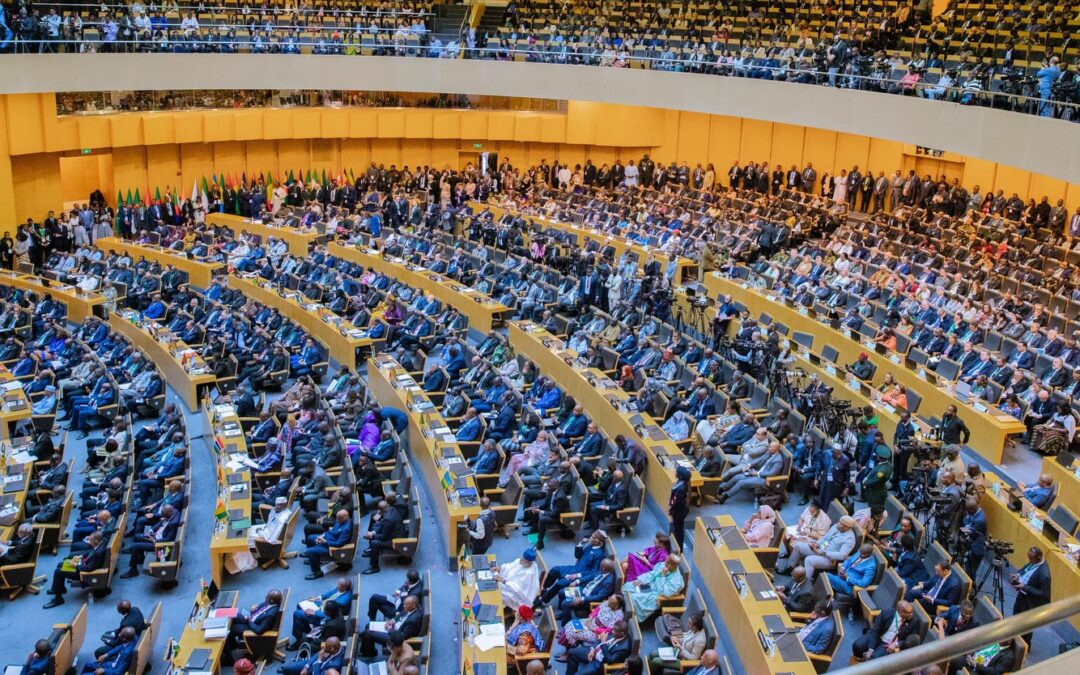
 The theme was noble: “Ensuring sustainable water availability and safe sanitation systems to achieve the goals of Agenda 2063.” World leaders descended upon Ethiopia’s capital. The UN Secretary-General made a poignant farewell. Italy’s Prime Minister spoke of equal partnership. The Palestinian Prime Minister thanked Africa for its solidarity. The rotating chairmanship passed from Angola’s João Lourenço to Burundi’s Évariste Ndayishimiye in a ceremony complete with handshakes, a symbolic gavel, and standing ovations.
 Heads of state, resplendent in tailored suits and colourful traditional regalia that cost more than most of their citizens will earn in a lifetime, stride across the stage to thunderous applause that is amplified through speakers and means nothing. They speak of water security as if water were a concept to be debated rather than a necessity to be delivered. They invoke Agenda 2063 as if a document could substitute for action. They promise to silence the guns by 2030, a date far enough away that they will not be held accountable when it arrives and the guns are still firing.
 The 39th Ordinary Session of the Assembly of the African Union, held in February 2026, was sold as a pivotal moment for the continent. The public relations machines of a dozen governments worked overtime to create this impression. The theme was noble, as summit themes always are: “Ensuring sustainable water availability and safe sanitation systems to achieve the goals of Agenda 2063.” Who could argue with water? Who could oppose sanitation? The theme was designed to be unobjectionable, to create consensus without controversy, to allow the dictators to appear concerned without being required to act.
 Yet beneath the polished surface of the summit transcript lies a more troubling reality. The words are there, preserved for posterity, a record of what was said. But the words do not tell the whole story. They do not reveal the deals made in corridors, the agreements reached in private, the conversations that never appear in any transcript. They do not reveal what was not said: the corruption not mentioned, the accountability not demanded, the consequences not threatened.
 João Lourenço, president of Angola since 2017, stood tall as he handed over the chairmanship. He spoke of his year of service, of his dedication to the continent. The man deserves our attention, not because of his words, but because of what his career represents. He presides over a nation that floats on oil—billions of dollars of it every year. And yet, Luanda’s streets are a monument to what happens when wealth meets an unaccountable elite. Potholes large enough to swallow small vehicles. Hospitals where patients bring their own bandages. Schools where children sit on floors because the furniture budget was reallocated to “security.”
 And this man—this product of a brutal system—is now the face of the African Union. He will speak for the continent. He will be photographed with world leaders. He will issue statements about democracy and good governance. And he will return to Burundi, where nothing he says in Addis will apply to the lives of his own citizens.
 Let us sit with this phrase: “owning our narrative.” It is seductive. It speaks to something real, something deeply felt by millions across the continent who have watched their homelands reduced to a postcard of misery on evening news broadcasts in London or Paris or Washington. The foreign correspondent flies in, films the hunger, interviews the grieving mother, and flies out. The complexity of a thousand cultures, the dignity of ordinary lives, the beauty of ordinary days—none of it makes the cut. What makes the cut is what sells: the spectacle of suffering.
 Agenda 2063 is a beautiful document. It really is. Read it sometime, if you can find a copy through the official channels—though you might have better luck searching the archives, where ambitious paperwork goes to rest. It speaks of “an integrated, prosperous and peaceful Africa, driven by its own citizens and representing a dynamic force in the international arena.” The prose is elegant. The aspirations are noble. The vision is, on paper, everything a continent could hope for.
 But let us be honest about what this phrase actually means. “Silencing the guns” is not a strategy. It is not a plan. It is a slogan carefully designed to sound like action while committing to nothing. It is the political equivalent of a man standing outside a burning building and announcing that he hopes the fire will go out.
 Meanwhile, allegations swirl that AU member states are actively arming the belligerents. The specifics matter less than the pattern: when the Ministry of Foreign Affairs of Sudan publicly accuses the AU Commission of bias and collaboration with external actors, it reveals an organisation so deeply compromised that its own members feel free to attack it in public. The moral authority the AU claims simply does not exist. It cannot, because the organisation is not independent of its members. It is its members. And its members are the very regimes that profit from conflict.
 And that, of course, will never happen. Because the men in that room have an agreement: we will not ask about your war if you do not ask about ours. We will not investigate your arms deals if you ignore our election fraud. We will not sanction your crimes if you look away from ours. It is a mutual protection society, and its highest value is not peace but solidarity—the solidarity of the guilty.
 So they speak of investment while protecting their monopolies. They speak of partnerships while excluding the people. They speak of governance reforms while maintaining systems designed to benefit the already powerful. The water crisis will not be solved by summits. It will be solved only when the people who control the water are forced to share it.
 He spoke of adaptation finance, of loss and damage funds, of a just transition from fossil fuels. His voice carried the weight of a man who has said these things many times before and watched them vanish into the void.
 Consider Angola’s oil fields. The country produces approximately 1.1 million barrels per day. The revenue has made some people extraordinarily wealthy, while leaving the majority in poverty. The gas flaring continues. The environmental degradation continues. The enrichment of the elite continues. And when the international community speaks of climate justice, Angolan officials nod gravely and demand compensation for the damage caused by historical emissions—while signing new production-sharing agreements with the same companies that caused the damage.
 Consider the evidence. The amount of money stolen from African economies through corruption and illicit financial flows is estimated at something like fifty to eighty billion dollars annually. That is more than the continent receives in development assistance. Every year, the dictators, and their networks extract wealth on a scale that dwarfs anything the IMF has ever demanded in repayment.
 Let that sink in. While the rest of the world ages and worries about who will pay pensions and staff hospitals, Africa grows younger and hungrier. While other regions debate how to integrate youth into prosperous economies, Africa debates how to prevent its youth from drowning in the Mediterranean. The demographic dividend, that great hope of development economists, has become a demographic disaster.
 The young know this. They watch the summits on whatever screens they can access. They see the old men applauding one another. They hear the speeches about the future. And they understand, with the clarity that comes from living the reality, that this future does not include them. They are not the beneficiaries of Agenda 2063. They are not the subjects of the speeches. They are not the audience for the declarations. They are the problem to be managed, the threat to be contained, the surplus population to be kept quiet until they age into irrelevance or explode.
 Corruption is not a peripheral issue in Africa. It is not a side effect or an unfortunate byproduct. It is central to understanding why this continent, with all its resources and all its potential, remains trapped in poverty while its rulers grow rich. It is the engine that drives the system, the fuel that keeps it running, the glue that holds it together.
 Lourenço came to power promising to clean house. He removed the dos Santos children from their positions. He talked accountability. And yet, the fundamental structures remain intact. The oil revenues still flow through channels that are opaque. The contracts still go to those with connections. The people still wait. Because Lourenço is not an outsider; he is a product of the same system. To dismantle it would be to dismantle himself.
 Every dictator in that hall knows that their colleagues are, to varying degrees, implicated in systems of patronage, kickbacks, and asset stripping. They know because they are implicated themselves. They know because their own rise depended on the same networks. They know because their continued survival requires the same flows of money to the same sets of loyalists.
 So the parasite continues to feed. It feeds in Angola, where oil money flows to the well-connected while the poor wait for services. It feeds in Ethiopia, where reconstruction contracts are awarded to cronies while the displaced wait to return home. It feeds in Cameroon, in Equatorial Guinea, in Uganda, in every country represented in that hall. It feeds undisturbed, because the only people who could stop it are the ones who benefit most from its feeding.
 “The future of Italy and Europe depends on Africa,” she said, her voice carrying the weight of apparent sincerity. “We cannot think about our future without giving due consideration to yours.”
 The applause was genuine. The sentiment was real. Many African countries have historical ties to the Palestinian cause, rooted in shared experiences of colonialism, in memories of displacement, in the solidarity of the oppressed. When Palestinians suffer, Africans recognise something familiar. When Palestinian leaders speak of injustice, Africans hear echoes of their own history.
 This is not to diminish the Palestinian cause. The suffering of Palestinians is real. The occupation is illegal. The displacement is devastating. The struggle for justice is legitimate and deserving of support. None of this is in question.
 Across the board, African governments are prone to statistical manipulation. This is not a secret. It is not a conspiracy theory. It is a well-documented pattern that economists, analysts, and international institutions have observed for decades.
 This is not a failure of the AU; it is its design. The organisation was created by dictators for dictators. Its foundational principle is the protection of incumbency, not the protection of people. Its members have a shared interest in ensuring that no leader is held accountable, because any leader held accountable today could be any of them tomorrow. The mutual protection society functions perfectly: we will not question your displacement of millions if you do not question our suppression of dissent.
 The external actors need local partners to access resources, to project power, to maintain influence. The dictators provide that access in exchange for protection, for money, for the means to stay in power. It is a transaction, and both sides benefit. The only ones who do not benefit are the people, who continue to suffer the consequences of decisions made far away by people who will never know their names.
 The African Union serves this interest perfectly. It provides legitimacy to regimes that have none. It offers diplomatic cover to leaders who should be isolated. It deflects criticism from external actors who might otherwise demand accountability. It enables the parasitic political classes to pose as statesmen while continuing to plunder.
 The legitimacy of the entire political class is crumbling. The old narratives—that development takes time, that progress is being made, that the future is bright—are no longer convincing to people who have heard them their entire lives and seen nothing change. The dictators are running out of excuses, running out of time, running out of credit with populations that have extended them far more than they ever deserved.

